
REMS Program Search Tool
Check if Your Medication Requires REMS
REMS programs are required for high-risk medications to ensure safe use. Enter a drug name to see if it has a REMS program and what requirements apply.
Enter a drug name to see if it requires a REMS program
When a drug can save your life but also carry a serious risk-like causing birth defects, dangerous drops in white blood cells, or sudden loss of consciousness after an injection-the FDA doesn’t just slap on a warning label and call it done. That’s where REMS programs come in. These aren’t simple warnings. They’re structured, legally required systems designed to make sure the benefits of a high-risk medication actually outweigh its dangers. And if you’re a patient, prescriber, or pharmacist, you’ve likely run into one without even realizing it.
What Exactly Is a REMS Program?
REMS stands for Risk Evaluation and Mitigation Strategies. It’s a formal FDA program created in 2007 under the Food and Drug Administration Amendments Act (FDAAA). It’s not for every drug. In fact, about 95% of FDA-approved medications don’t need one. REMS is only required for drugs with serious, potentially life-threatening risks that can’t be managed through standard prescribing guidelines or package inserts alone.
Think of it this way: standard drug labels tell you what could go wrong. REMS tells you exactly how to prevent it. The FDA doesn’t use REMS to eliminate risk-that’s often impossible for drugs treating aggressive cancers, severe mental illness, or rare autoimmune disorders. Instead, REMS makes sure those risks are controlled so the drug can still be used safely.
Some of the earliest REMS programs were created for drugs like isotretinoin (Accutane), which can cause severe birth defects, and thalidomide, infamous for causing limb deformities in babies born to mothers who took it in the 1950s. Even decades later, these drugs still require strict controls. Today, the FDA oversees 78 active REMS programs covering about 150 medications.
How REMS Works: The Three Main Elements
Not all REMS programs are the same. Each one is custom-built around the specific danger of the drug. But they all include at least one of these three core components:
- Medication Guides: These are printed handouts given to patients that explain the risks in plain language. For example, patients getting clozapine (used for treatment-resistant schizophrenia) get a guide explaining the risk of agranulocytosis-a dangerous drop in white blood cells.
- Communication Plans: These are directed at healthcare providers. They might include training modules, emails, or alerts reminding doctors about monitoring requirements. For instance, prescribers of Zyprexa Relprevv, a long-acting antipsychotic injection, must be trained on how to handle post-injection delirium sedation syndrome, a rare but serious reaction.
- Elements to Assure Safe Use (ETASU): This is the strictest level. ETASU can require prescribers to be certified, patients to enroll in a registry, pharmacies to be specially trained, or even that the drug be given only in a hospital or clinic under supervision.
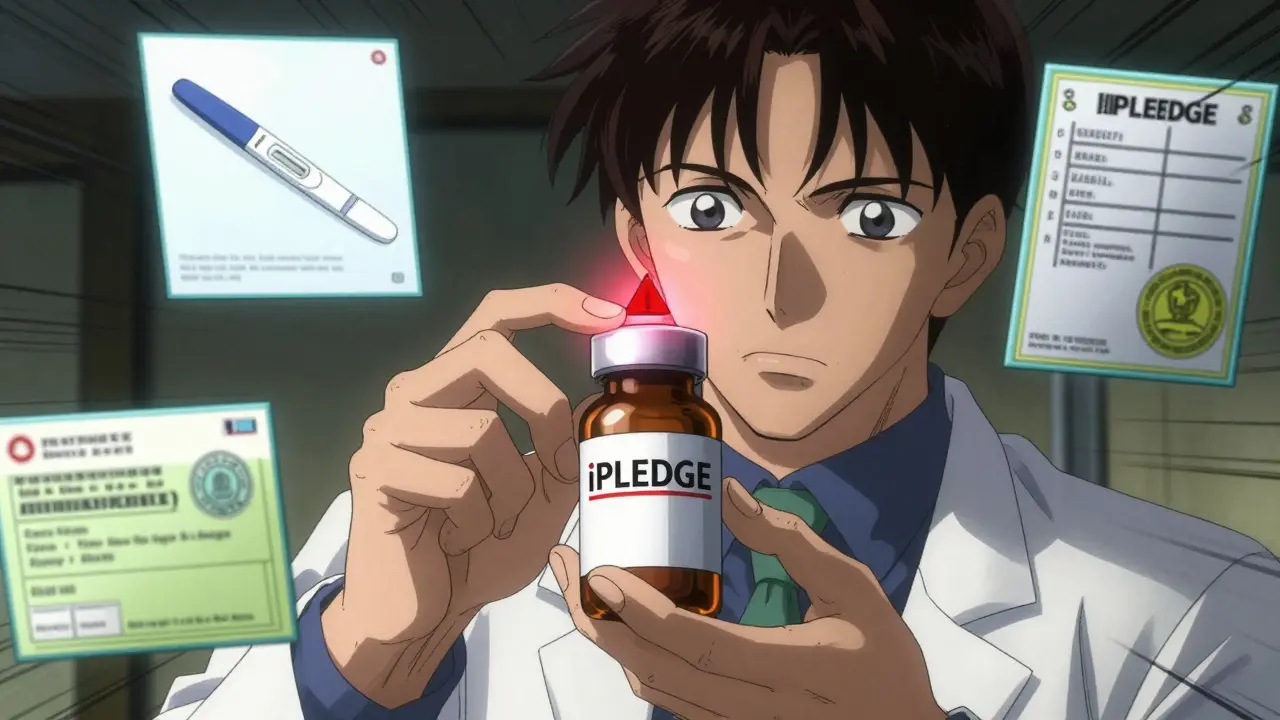
Take the iPLEDGE program for isotretinoin. To get this acne medication, a patient must be registered in a national database, have two negative pregnancy tests, and receive counseling. The pharmacy must verify all of this before dispensing. It’s a lot of steps-but without them, the risk of fetal exposure is too high.
Who’s Responsible for Running REMS?
The FDA sets the rules, but the drugmaker pays the bill and runs the show. Pharmaceutical companies are required to design, fund, and maintain their own REMS programs. That means a company like Johnson & Johnson, which makes Zyprexa Relprevv, has to build a system that trains doctors, tracks patients, and ensures pharmacies follow protocol.
This model has pros and cons. On one hand, it puts the burden on the company that profits from the drug, which creates incentive to make the program efficient. On the other hand, it leads to a patchwork of systems. There are 78 REMS programs, each with its own website, login, verification process, and training modules. Many don’t talk to each other-or to electronic health records.
As of 2023, only 35% of REMS programs integrate directly with EHRs. That means pharmacists often have to manually check a patient’s status across multiple portals, adding 15 to 20 minutes per REMS medication dispensed. One hospital pharmacist told Pharmacy Times they spend 2 to 5 extra hours a week just managing REMS paperwork.

Who Gets Affected-and How?
REMS doesn’t just slow down prescriptions. It changes how care is delivered.
Patients often face delays. A 2019 study in JAMA Internal Medicine found that REMS drugs took an average of 5.4 days longer to be prescribed than non-REMS drugs. For someone with a rare disease who needs to travel hours for a specialist, a week-long delay can mean worsening symptoms or hospitalization.
Doctors report frustration too. A 2022 American Medical Association survey found that 68% of physicians had experienced delays in starting REMS-required medications. Nearly half said those delays hurt patient outcomes.
Pharmacists are on the front lines. For clozapine, patients need weekly blood tests for the first six months. Pharmacists must confirm those results before filling the prescription. If the lab result isn’t in the system, or if the patient forgot to get tested, the prescription sits. One Reddit thread from a pharmacist described waiting for hours because the iPLEDGE portal was down.
And it’s not just about inconvenience. For patients in rural areas or without reliable transportation, REMS can become a barrier to care. The National Organization for Rare Disorders pointed out in 2023 that many REMS programs assume patients can easily access specialized clinics-which isn’t true for everyone.
Are REMS Programs Working?
There’s no simple answer. Experts agree REMS has made a difference. Dr. Robert Temple, former FDA deputy director, said REMS allowed life-saving drugs to be approved that otherwise wouldn’t have been. Thalidomide, once banned, is now used to treat multiple myeloma and leprosy-because of its REMS program.
But critics say some programs have outlived their usefulness. In August 2023, the FDA allowed the first REMS program to be discontinued-thalidomide’s-because better alternatives and education had reduced the risk enough. That’s a sign the system can evolve.
Still, a 2023 joint FDA-PhRMA report found that 63% of REMS programs lack clear metrics to prove they’re actually improving safety. Are prescriber training modules reducing errors? Is patient registry enrollment lowering adverse events? Often, no one knows.
And the cost is high. The pharmaceutical industry spends an estimated $1.2 billion a year on REMS. Some programs cost $500,000 annually. Others, like those requiring patient registries and specialized dispensing, cost over $15 million.

What’s Changing in REMS?
The FDA is trying to fix what’s broken. In 2023, they launched the REMS Integration Initiative, which is standardizing 22 of the 78 programs onto a single platform. The goal: reduce redundancy and make it easier for providers to comply.
They’re also pushing for digital solutions. Pilot programs are testing smartphone apps that let patients log blood test results or report side effects in real time. One trial is using a mobile app for anticoagulants to replace in-person monitoring visits.
The FDA’s 2024-2026 plan says they’ll focus on two things: reducing access barriers and measuring real-world effectiveness. New REMS proposals must now include a plan to assess whether the program creates unnecessary delays, especially for underserved populations.
And the trend is clear: more drugs will need REMS. Evaluate Pharma predicts that by 2027, 45% of new oncology drugs will require one-up from 38% in 2023. As treatments get more targeted, they often come with more side effects. REMS will likely grow, not shrink.
What Should You Do If You’re Affected by REMS?
If you’re a patient prescribed a REMS drug:
- Ask your doctor early: “Does this medication have a REMS program?”
- Find out what steps you need to take-registration, testing, training.
- Don’t wait until your prescription is ready to start the process. It can take days or weeks.
- Reach out to the REMS program’s website. Most have patient support lines.
If you’re a healthcare provider:
- Register for REMS training as soon as you plan to prescribe the drug.
- Keep track of certification expiration dates-some require renewal every year.
- Use the FDA’s REMS Dashboard to check which programs are active and what they require.
- Advocate for better integration with your EHR system.
If you’re a pharmacist:
- Build a checklist for REMS verification to avoid missing steps.
- Know which REMS programs have direct EHR links-and which don’t.
- Document delays and report them to your pharmacy’s compliance team. Data drives change.
REMS isn’t perfect. But for drugs that could kill as easily as they heal, it’s the best tool we have. The challenge now is making it smarter-not just stricter.
What drugs require a REMS program?
REMS applies to prescription drugs with serious safety risks that can’t be managed through standard labeling. Examples include isotretinoin (for acne), clozapine (for schizophrenia), thalidomide (for cancer and leprosy), Zyprexa Relprevv (an antipsychotic injection), and certain extended-release opioids. As of 2023, the FDA lists 78 active REMS programs covering about 150 medications, mostly in oncology, neurology, and immunology.
Who pays for REMS programs?
The pharmaceutical company that makes the drug is responsible for designing, funding, and running the REMS program. This includes training prescribers, maintaining patient registries, managing pharmacy verification systems, and reporting data to the FDA. The industry spends an estimated $1.2 billion per year on REMS implementation.
Can REMS programs be removed?
Yes. The FDA can remove or modify a REMS program if new data shows the risks are better managed through other means. In August 2023, the FDA discontinued the REMS for thalidomide after 20 years, because improved education and alternative treatments reduced the risk enough. This is rare, but it shows REMS isn’t permanent.
Do REMS programs delay patient care?
Yes, often. Studies show REMS drugs take an average of 5.4 days longer to be prescribed than non-REMS drugs. A 2022 AMA survey found 68% of physicians experienced delays, and 42% said those delays hurt patient outcomes. Pharmacists report spending 15-20 extra minutes per REMS prescription on verification steps.
How can I find out if my medication has a REMS program?
Check the FDA’s official REMS Dashboard at fda.gov/rems. Your prescriber or pharmacist should also be able to tell you. The drug’s prescribing information (package insert) will list REMS requirements under the “Warnings and Precautions” or “Patient Counseling Information” section.
Are REMS programs the same as the EU’s Risk Management Plans?
No. In the European Union, all new medicines require a Risk Management Plan (RMP), which is a standard requirement. In the U.S., REMS is only used for drugs with the most serious risks-about 5% of approved medications. U.S. REMS programs are more targeted and often include stricter controls like mandatory registries or in-clinic administration.



Marian Gilan
January 26, 2026 AT 16:07Conor Murphy
January 27, 2026 AT 15:21Conor Flannelly
January 28, 2026 AT 20:31Patrick Merrell
January 30, 2026 AT 04:23Dan Nichols
January 31, 2026 AT 18:38Renia Pyles
February 1, 2026 AT 08:37Rakesh Kakkad
February 1, 2026 AT 16:59Shweta Deshpande
February 2, 2026 AT 15:04Robin Van Emous
February 3, 2026 AT 22:05