

When it comes to kidney disease, not everyone has the same risk. For people with recent African ancestry, there’s a genetic factor that plays a huge role-one that explains nearly 70% of the extra risk seen in this group compared to others. This isn’t about race as a social category. It’s about ancestry, evolution, and a gene called APOL1 a gene that evolved in sub-Saharan Africa to fight a deadly parasite but now increases the risk of kidney damage in modern environments.
What Is APOL1 and Why Does It Matter?
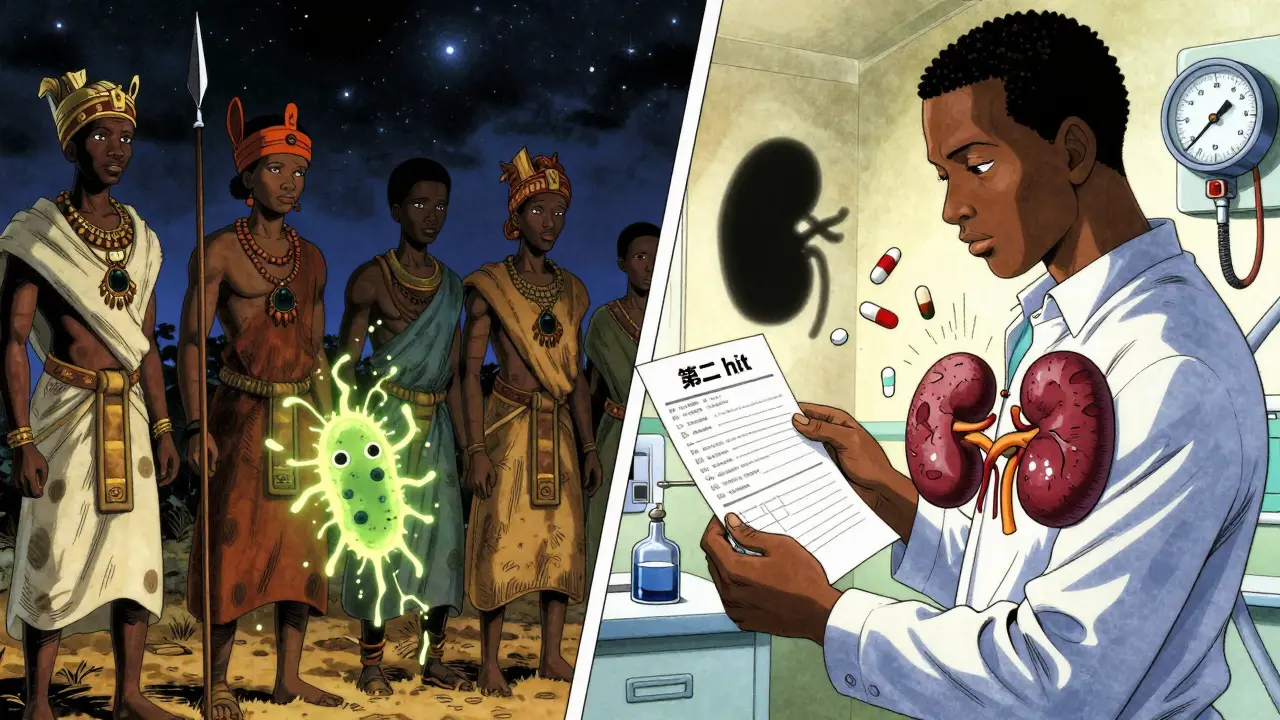
The APOL1 gene produces a protein that helps the immune system destroy certain parasites. Around 3,000 to 10,000 years ago, in West and Central Africa, two versions of this gene-called G1 and G2-emerged. These versions made people more resistant to Trypanosoma brucei rhodesiense the parasite that causes African sleeping sickness. That survival advantage meant people with these variants were more likely to live, have children, and pass them on.
Today, those same variants are found in about 30% of people with recent West African ancestry. That includes African Americans, Afro-Caribbeans, and others whose families trace back to those regions. But here’s the twist: while those variants helped our ancestors survive infection, they now increase the risk of kidney disease. It’s a classic case of evolution catching up with modern life.
How Do APOL1 Variants Cause Kidney Damage?
The APOL1 protein normally attacks parasites by punching holes in their membranes. But in people with two copies of a risk variant-either G1/G1, G2/G2, or G1/G2-the same protein starts attacking kidney cells. This leads to inflammation and scarring in the filtering units of the kidney, called glomeruli.
The kidney diseases most strongly linked to these variants include:
- Focal segmental glomerulosclerosis (FSGS)
- Collapsing glomerulopathy
- HIV-associated nephropathy (HIVAN)
- Arterionephrosclerosis
Here’s what’s striking: if you’re African American and have non-diabetic kidney disease, about 50% of you carry these high-risk APOL1 genotypes. In fact, nearly half of all end-stage kidney disease cases in African ancestry populations with HIV are tied to APOL1. That’s not a coincidence-it’s biology.
Not Everyone With the Variant Gets Sick
Here’s the good news: most people with high-risk APOL1 genotypes never develop kidney disease. About 70% of carriers still have normal kidney function. That’s because having the gene isn’t enough. Something else has to trigger the damage-what researchers call a "second hit." These triggers can include:
- HIV infection
- COVID-19
- High blood pressure
- Obesity
- Chronic stress
- Other genetic factors
That’s why some people with the variant stay healthy for life, while others develop kidney failure in their 30s or 40s. It’s not just genetics-it’s lifestyle, environment, and timing.
Why This Disparity Exists
African Americans are 3 to 4 times more likely to develop kidney failure than white Americans. For decades, doctors assumed it was due to poverty, diet, or access to care. Those things matter-but they don’t explain the full gap.
APOL1 variants account for about 70% of that difference. The variants are virtually absent in European, Asian, and Indigenous American populations. So when you see kidney disease rates jump in African ancestry groups, this gene is the biggest single reason why.
And here’s something critical: this isn’t about race. It’s about ancestry. Two people who identify as "Black" can have very different genetic backgrounds. Someone with roots in Nigeria may carry the variant, while someone with roots in Ethiopia or South Africa may not. The gene follows geographic ancestry, not racial labels.
Who Should Get Tested?
APOL1 testing became available in 2016. Today, it’s recommended for:
- People of African ancestry with unexplained kidney disease
- Living kidney donors with African ancestry
- People with HIV and kidney damage
- Those with a family history of early kidney failure
The test looks for two specific variants: G1 and G2. You need two copies (homozygous or compound heterozygous) to be considered high-risk. A single copy doesn’t raise your risk significantly.
The cost? Around $250 to $450 without insurance. Some labs offer discounts, and a few insurance plans now cover it if there’s a clear medical reason. The NIH recommends testing for potential kidney donors because if you carry the high-risk genotype, donating a kidney could put your own kidney health at risk.
What Happens After a Positive Test?
Knowing you have a high-risk APOL1 genotype isn’t a death sentence. It’s a heads-up. The goal isn’t to panic-it’s to act.
Current guidelines from the American Society of Nephrology (2023) say:
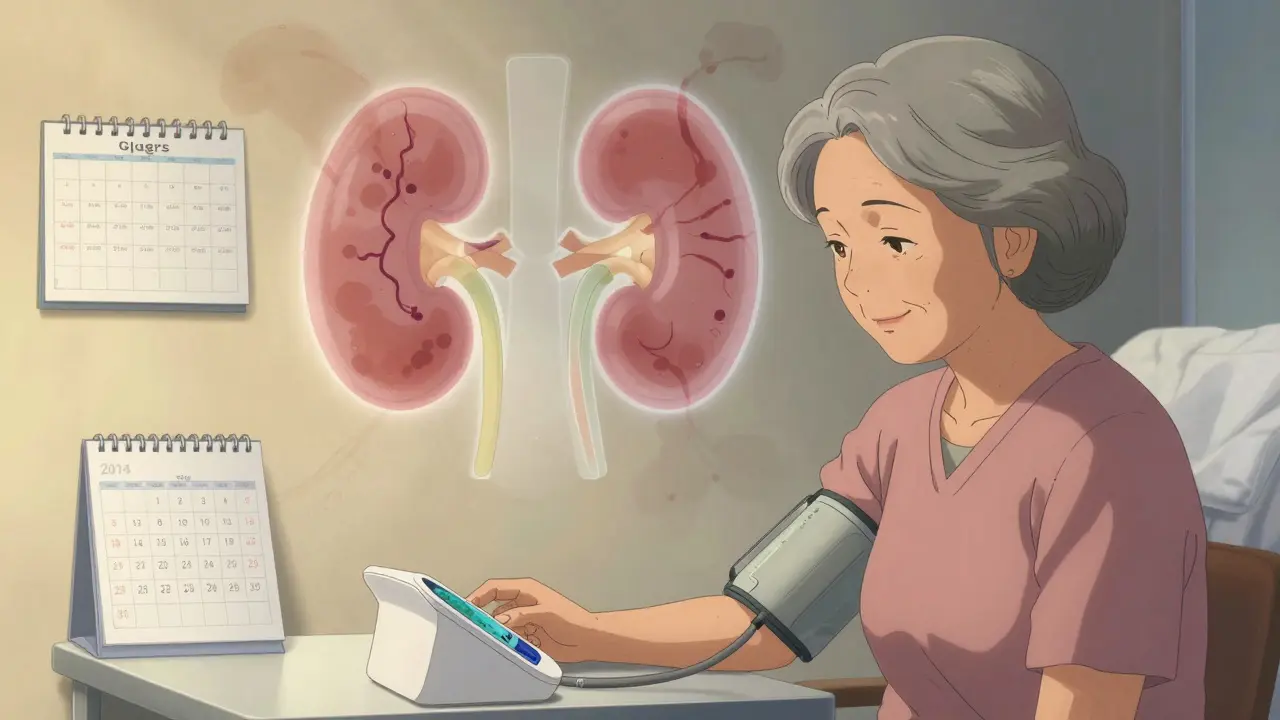
- Check your urine for protein (albumin-to-creatinine ratio) once a year
- Keep your blood pressure below 130/80 mmHg
- Avoid NSAIDs like ibuprofen and naproxen
- Manage diabetes and obesity if you have them
- Get regular kidney function tests (eGFR)
One woman, Emani, found out she carried the variant during a routine checkup. She didn’t have symptoms. But because she knew her risk, she started monitoring her blood pressure, cut back on salt, and got annual urine tests. Five years later, her kidneys are still working fine.
On the other hand, some people don’t get the message. A 2023 study found that 35% of patients thought a positive test meant they would definitely get kidney disease. That’s not true. Only 15% to 20% of people with high-risk genotypes develop kidney failure in their lifetime.
What’s Being Done About It?
Big changes are underway. The NIH launched the APOL1 Observational Study (AOS) a 10-year study tracking 5,000 people with high-risk genotypes to better understand what triggers kidney damage.
Pharmaceutical companies are racing to develop drugs that block the harmful effects of APOL1. Vertex Pharmaceuticals’ drug VX-147 showed promising results in late 2023: a 37% drop in proteinuria after just 13 weeks. That’s a big deal-protein in the urine is a sign of kidney damage. Reducing it could delay or even prevent kidney failure.
The American Medical Association dropped race-based kidney function calculations in 2022 because APOL1 research proved that genetic ancestry matters more than race. Now, doctors are starting to use genetic data instead of assumptions.
The Bigger Picture: Equity and Access
Here’s the hard truth: while the science is advancing, access isn’t. Only 12% of low- and middle-income countries offer APOL1 testing. That means someone in Ghana or Nigeria might carry the variant and never know it. Meanwhile, in the U.S., many Black patients report being dismissed by doctors for years before getting tested.
One patient shared on Reddit: "I went to five doctors before one listened when I said my kidneys were failing. They thought I was just stressed." That’s not just a personal story-it’s a systemic failure.
Equity means making testing available everywhere, not just in wealthy clinics. It means training doctors to understand ancestry, not just race. And it means listening to patients who know their bodies best.
What You Can Do
If you have African ancestry and haven’t been tested:
- Ask your doctor if APOL1 testing is right for you
- Get your blood pressure checked regularly
- Monitor your urine for foam or swelling-signs of protein leakage
- Stay away from painkillers like ibuprofen if you have kidney concerns
- Know your family history-kidney disease in parents or siblings? That’s a red flag
And if you’ve already been tested: don’t panic. You’re not doomed. You’re informed. And that’s the first step toward protecting your health.
Can APOL1 variants be passed down to children?
Yes. APOL1 risk variants are inherited in an autosomal recessive pattern. That means you need to get one copy from each parent to be at high risk. If you have one risk variant, your children might inherit it-but they won’t be at high risk unless they get another from the other parent. Genetic counseling can help families understand inheritance patterns.
Is APOL1 testing covered by insurance?
Coverage varies. Some insurers cover it if you have unexplained kidney disease, are a potential kidney donor, or have HIV-related kidney damage. Others don’t. It’s best to check with your provider and ask for a pre-authorization. The American Kidney Fund offers financial assistance for testing in eligible cases.
Can lifestyle changes reduce APOL1-related kidney risk?
Absolutely. While you can’t change your genes, you can control triggers. Keeping blood pressure under 130/80, avoiding NSAIDs, managing weight, and not smoking can significantly lower your chance of kidney damage. Studies show that people with high-risk APOL1 who follow these steps have much slower disease progression.
Why is APOL1 testing not routine for everyone with African ancestry?
Because most people with the variant never develop kidney disease. Testing everyone would cause unnecessary anxiety and cost billions without clear benefit. Current guidelines recommend testing only when there’s a medical reason-like unexplained kidney damage or being a potential donor. Future screening guidelines may change as we learn more.
Do APOL1 variants affect kidney transplant outcomes?
Yes. People with high-risk APOL1 genotypes who receive a kidney transplant from a donor without the variant usually do well. But if the donor also has high-risk APOL1, the transplanted kidney is more likely to fail. That’s why donors of African ancestry are now routinely tested before donation.
Looking Ahead
The story of APOL1 is a reminder that biology doesn’t care about our categories. Evolution didn’t plan for modern diets, stress, or long lifespans. What helped our ancestors survive is now a health risk for us.
But science is catching up. With better testing, targeted drugs, and smarter guidelines, we’re moving toward a future where kidney disease in African ancestry populations isn’t inevitable-it’s preventable. The key isn’t to blame genes. It’s to use them-to act early, stay informed, and demand better care.



tatiana verdesoto
March 1, 2026 AT 19:53Just read through this whole thing and honestly? I’m glad someone finally laid it out like this. I’ve got family members with kidney issues and no one ever connected the dots until now. It’s not about race-it’s about ancestry, and that distinction matters more than we think.
My aunt got tested after her third kidney scare, turned out she had the double variant. She’s 58, no diabetes, no hypertension-just genetics. Now she’s on a strict low-sodium diet, avoids ibuprofen like it’s poison, and gets her urine checked every six months. She’s still kicking. No dialysis. No transplant. Just awareness.
Also, shoutout to Emani. That’s the kind of story we need more of. Not fear. Not guilt. Just action.
Jane Ryan Ryder
March 2, 2026 AT 15:30So let me get this straight-we’re now blaming Black people’s kidneys for being ‘evolutionarily optimized’ for parasites? Cute. Next you’ll tell me their sweat glands are too efficient because they used to survive the savannah.
Meanwhile, white folks get to blame their heart disease on ‘bad genes’ while Black folks get handed a genetic scarlet letter. Thanks for the science, I guess.
Ethan Zeeb
March 4, 2026 AT 08:48You’re missing the point entirely. This isn’t about blame. It’s about biology. APOL1 isn’t a racial marker-it’s a geographic one. Someone from Ghana and someone from Jamaica might both carry it. Someone from Ethiopia? Probably not. Race is a social construct. This? This is evolution in real time.
And yes, it’s uncomfortable. But pretending it doesn’t exist because it makes people feel bad doesn’t help anyone. Knowledge is the first step toward equity-not the enemy of it.
RacRac Rachel
March 5, 2026 AT 11:17THIS. IS. SO. IMPORTANT. 🙌
I work in public health and I’ve seen too many patients get dismissed because ‘they’re just Black’ and ‘kidney stuff runs in their family.’ No. It’s APOL1. It’s a gene. Not a stereotype.
My cousin got tested after her dad went on dialysis at 42. She’s 31. Normal kidneys. Now she knows. She drinks water. She doesn’t take Advil. She checks her BP. She’s in control. And that’s everything.
Let’s get testing into community clinics. Let’s stop making it a luxury. 💪🩺
Chris Beckman
March 6, 2026 AT 15:16So you’re telling me if I’m black and I eat chips and soda I’m gonna die early? Well duh. That’s not genetics that’s just being lazy. I’ve got black friends who run marathons and don’t even have high blood pressure. So maybe stop blaming genes and start blaming bad habits? 🤷♂️
Also why are we testing donors? Sounds like a way to scare people out of donating. I’m gonna go cry now.
Justin Rodriguez
March 7, 2026 AT 04:33Let me clarify something that’s been lost in the noise: APOL1 risk isn’t deterministic. It’s probabilistic. Having two risk alleles increases your odds-but doesn’t guarantee disease. That’s why the ‘second hit’ concept is so critical.
HIV, obesity, hypertension, NSAID overuse-they’re the accelerants. Without them, most carriers live with normal kidney function. That’s why prevention isn’t about gene editing. It’s about public health interventions: better access to BP meds, education on NSAID risks, screening in primary care.
And yes, testing potential donors is non-negotiable. You don’t give someone a kidney and then accidentally doom their own life because you didn’t check. That’s medical ethics 101.
This isn’t about race. It’s about precision medicine. And we’re finally getting there.
Levi Viloria
March 9, 2026 AT 00:30I’m Nigerian-American. My dad had kidney failure in his late 40s. We never knew why. Now I get it. APOL1. Not ‘poor diet.’ Not ‘no insurance.’ Not ‘they don’t care.’
But here’s the thing-I’ve been to Nigeria. No one there gets tested. No one even knows the name. Meanwhile, in the U.S., we’re having this conversation. That’s progress.
But equity means making sure the knowledge doesn’t stop at the Atlantic. We need labs in Lagos. We need doctors in Accra trained on this. Not just in Atlanta.
Genetics doesn’t care about borders. Our healthcare systems should stop pretending they do.
Betsy Silverman
March 9, 2026 AT 20:26Thank you for writing this. As a Black woman who’s spent years fighting to be heard in medical settings, this article feels like validation.
I’ve been told my kidney issues were ‘stress-related’ three times before someone finally ordered the APOL1 test. Turned out I had G1/G1. My mom had the same. Her sister’s on dialysis.
It’s not about guilt. It’s about power. Knowing this gives me control. I track my protein levels. I avoid NSAIDs. I drink water. I’m not scared-I’m prepared.
And if you’re reading this and have African ancestry? Ask your doctor. Just ask. You’ve got nothing to lose and everything to gain.
Zacharia Reda
March 11, 2026 AT 07:09So let me get this straight-some people are saying we should test everyone with African ancestry? That’s a terrible idea.
15-20% lifetime risk. 70% of carriers are fine. Testing everyone creates panic, wasted resources, and insurance nightmares.
Targeted testing? Yes. For people with unexplained kidney disease. For donors. For those with family history.
But blanket screening? That’s not science. That’s fear-driven policy. And we’ve seen how that ends.
Ivan Viktor
March 12, 2026 AT 02:30Wow. So we’re doing genetic testing now? Next you’ll be telling me to scan my DNA before ordering a burger. I’m out.
Also, if you’re gonna blame evolution, why not just say ‘Black people are fragile’ and get it over with?
Raman Kapri
March 12, 2026 AT 04:28This article is a classic example of Western medical colonialism. You take a genetic variant from Africa, label it a ‘disease risk,’ and then act like Africans are broken. Meanwhile, in India, we have our own kidney epidemics from pollution, pesticides, and poor sanitation. But you don’t write articles about that.
Why? Because APOL1 is convenient. It shifts blame away from systemic neglect and onto biology. Smart. Very smart.
Callum Duffy
March 13, 2026 AT 05:23An exceptionally well-researched and nuanced exposition. The distinction between race and ancestry is not merely semantic-it is foundational to ethical medical practice. The fact that APOL1 variants are absent in non-African-descended populations underscores the necessity of moving beyond race-based clinical algorithms.
That said, the disparity in global access to testing remains a profound ethical failing. The science is clear. The infrastructure is not. Until this is addressed, we risk turning a biological insight into a new form of health inequity.