
HIV Medication Interaction Checker
Check Your Medications
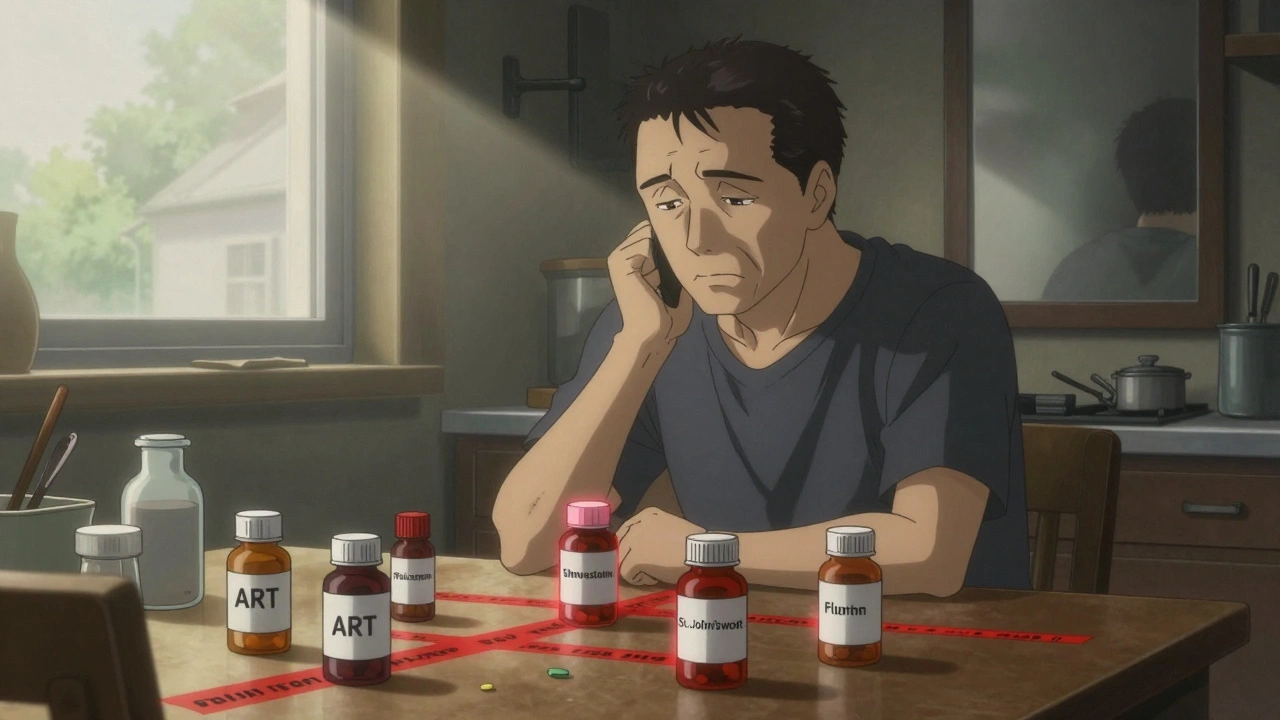
When you're on antiretroviral therapy (ART) for HIV, taking the right pills every day isn't the only thing that matters. What you don't take - or what you take alongside your HIV meds - can be just as critical. Many people living with HIV are also managing high blood pressure, diabetes, cholesterol, depression, or chronic pain. And that’s where things get dangerous. Some of the most common medications people use every day can interact with their HIV drugs in ways that are silent, serious, and sometimes deadly.
Why These Interactions Happen
Most antiretroviral drugs are broken down in your liver by enzymes called cytochrome P450, especially CYP3A4. Some HIV meds slow down this process. Others speed it up. When that happens, other drugs either build up to toxic levels or get flushed out before they can work. It’s not about allergies or side effects - it’s about chemistry. And it’s happening more often than you think.According to the U.S. Department of Health and Human Services, about 40-60% of people with HIV over 50 are taking five or more medications at once. That’s polypharmacy. And for every extra pill you add, your risk of a dangerous interaction goes up by 18%. If you’ve been on ART for 10 years or more, your risk climbs another 7% per year. This isn’t rare. It’s routine.
The Worst Offenders: Boosted PIs
Not all HIV drugs are created equal when it comes to interactions. The biggest troublemakers are protease inhibitors (PIs) like darunavir and atazanavir - especially when they’re boosted with ritonavir or cobicistat. These boosters were designed to make the HIV drugs work better. But they also turn your liver into a traffic jam for other medications.Ritonavir alone has over 200 documented drug interactions. Cobicistat isn’t far behind. Together, they block CYP3A4 so strongly that even small doses of other drugs can become dangerous. For example:
- Simvastatin and lovastatin - common cholesterol drugs - can spike to 20-30 times their normal levels, leading to muscle breakdown (rhabdomyolysis), kidney failure, or death.
- Fluticasone (an inhaled steroid for asthma) can cause Cushing’s syndrome or adrenal failure when used with boosted PIs. One study found 17% of patients on these combinations ended up hospitalized.
- Amlodipine, a blood pressure pill, can cause severe low blood pressure when its levels rise 1.6-fold due to ritonavir.
These aren’t theoretical risks. They’re real, documented, and preventable.
What About INSTIs? Safer, But Not Risk-Free
Integrase inhibitors like dolutegravir and bictegravir are now the first-line choice for most people starting HIV treatment. Why? Because they have far fewer interactions. Dolutegravir only has about 8 major ones. Bictegravir? Just seven. That’s a massive improvement over ritonavir’s 217.But don’t assume they’re harmless. Dolutegravir reduces metformin levels by 33%, which can mess with blood sugar control in people with diabetes. Bictegravir drops to just 29% of its normal concentration when taken with rifampin - a TB drug. That’s enough to cause HIV treatment failure.
And if you’re on long-acting injectables like cabotegravir and rilpivirine? The risk doesn’t go away after your last shot. These drugs stay in your body for months - up to a year. So if you start a new medication after your last injection, you could still have an interaction. No one talks about this enough.

Statins, SSRIs, and Erectile Dysfunction Drugs: The Hidden Traps
Heart disease is the leading cause of death for people with HIV over 50. That means statins are common. But only two are safe with boosted PIs: pitavastatin and fluvastatin. Everything else - simvastatin, atorvastatin, rosuvastatin - is risky. Even at low doses.Antidepressants are another minefield. SSRIs like fluoxetine can cause serotonin syndrome when mixed with ritonavir. That’s a life-threatening condition with high fever, confusion, rapid heartbeat, and muscle rigidity. One case report described a patient who needed to cut his fluoxetine dose in half just to stay safe.
Erectile dysfunction meds? Sildenafil (Viagra) is okay - but only if you cut the dose to 25mg every 48 hours. Avanafil? Completely off-limits. The interaction can spike its levels 4-5 times, leading to dangerously low blood pressure, fainting, or heart attack.
Herbs, Supplements, and Recreational Drugs
People don’t always think of St. John’s Wort as a drug. But it’s one of the most dangerous herbal supplements for people on ART. It’s a strong CYP3A4 inducer. If you’re on efavirenz, St. John’s Wort can slash its levels by 50-60%. That’s like skipping doses for weeks. Treatment failure. Resistance. Transmission risk.Even OTC painkillers can be tricky. While acetaminophen is generally safe, long-term use with ART can stress your liver. NSAIDs like ibuprofen are okay for short-term use, but if you’re on tenofovir and have kidney issues, they can make things worse.
And recreational drugs? Ketamine, MDMA, and cocaine can have unpredictable, prolonged effects when combined with ritonavir. Your body can’t break them down fast enough. That’s not just a bad trip - it’s a medical emergency.
What You Need to Do Right Now
If you’re on ART, here’s what you must do:- Make a full list of every medication you take - including vitamins, supplements, herbal teas, and OTC drugs. Don’t leave anything out.
- Take that list to your doctor or pharmacist every single time you refill your HIV meds - even if nothing seems to have changed.
- Use the University of Liverpool HIV Drug Interactions Checker (it’s free and updated monthly). It’s the gold standard. Type in your exact meds and see what pops up.
- If you’re on a boosted PI, ask: “Could any of my other meds be building up to toxic levels?”
- If you’re on dolutegravir and take metformin, ask for a blood sugar check. Your dose may need adjusting.
- If you’re on long-acting injections, remind your provider that interactions can still happen months after your last shot.
Many people don’t realize their pharmacist can help. Pharmacists are trained to spot these interactions. But they can’t help if they don’t know what you’re taking. Tell them everything.

The Bigger Picture
The HIV population is aging. More than half of people diagnosed with HIV in the U.S. are now over 50. That means more heart disease, more diabetes, more arthritis, more depression - and more medications. The old days of just taking three pills for HIV are gone. Now it’s five, ten, sometimes fifteen.That’s why the future of HIV care isn’t just about new drugs - it’s about cleaner ones. New drugs like lenacapavir, injected twice a year, have minimal liver interactions. The NIH is investing $12.7 million in 2024 to develop even safer options. By 2030, experts predict next-gen ART will have 80% fewer dangerous interactions than today’s boosted PIs.
But until then, you can’t wait for science to fix it. You have to protect yourself. Every pill you take - prescribed or not - could be a hidden risk. The good news? You don’t need to be a doctor to understand this. You just need to ask the right questions.
What to Ask Your Provider
Don’t leave your appointment without these answers:- “Which of my medications could be interacting with my HIV drugs?”
- “Is there a safer alternative for this other drug?”
- “Do I need to change my dose if I switch from a boosted PI to an INSTI?”
- “What should I do if I start or stop any new medication - even a cold pill?”
There’s no shame in asking. In fact, the most successful patients are the ones who ask the most.
Can I take ibuprofen with my HIV meds?
Yes, ibuprofen is generally safe with most antiretroviral drugs for short-term use. But if you’re on tenofovir and have kidney issues, long-term use can increase the risk of kidney damage. Always talk to your provider before using NSAIDs regularly, especially if you’re older or have other health conditions.
Is it safe to take St. John’s Wort with ART?
No. St. John’s Wort is a strong inducer of CYP3A4 and can reduce levels of efavirenz, nevirapine, and some PIs by up to 60%. This can lead to HIV treatment failure and drug resistance. Avoid it completely if you’re on ART. There are safer alternatives for depression and anxiety.
What’s the safest statin to take with HIV meds?
Pitavastatin and fluvastatin are the safest options for people on boosted protease inhibitors. Simvastatin and lovastatin are absolutely contraindicated - they can cause life-threatening muscle damage. Atorvastatin and rosuvastatin can be used with caution and lower doses, but only under close monitoring.
Can I use Viagra if I’m on HIV treatment?
Sildenafil (Viagra) can be used, but only at a reduced dose: 25mg every 48 hours, not the standard 50-100mg. This is especially important if you’re on ritonavir or cobicistat. Avanafil, tadalafil, and vardenafil have even higher interaction risks and should be avoided unless your provider specifically approves a dose adjustment.
What should I do if I’m switching from a boosted PI to dolutegravir?
When you switch from a ritonavir-boosted PI to dolutegravir, your body will start metabolizing other drugs faster. That means doses of drugs like tacrolimus, cyclosporine, or certain anti-seizure medications may need to be cut by 50-75%. Never switch without your provider adjusting these doses - doing so could lead to organ rejection or seizures.
Are long-acting HIV injections safer for drug interactions?
They’re simpler to manage because you’re not taking daily pills, but they’re not interaction-proof. Cabotegravir and rilpivirine stay in your system for up to a year. So if you start a new medication - even a new antibiotic or painkiller - after your last injection, you could still have a dangerous interaction. Always tell your provider you’re on long-acting ART, even if you haven’t had a shot in months.
How often should I check for drug interactions?
Every time you start, stop, or change any medication - even a one-time OTC painkiller or a new vitamin. Also check after any hospital visit or when your provider changes your HIV regimen. Use the University of Liverpool’s HIV Drug Interactions Checker (hiv-druginteractions.org) as your go-to tool. It’s free, updated monthly, and trusted worldwide.
Final Thoughts
You’re not alone in this. Thousands of people with HIV are managing complex medication regimens. But most of them don’t realize how many of their daily pills could be quietly undermining their health. The key isn’t fear - it’s awareness. Know what you’re taking. Know what it does. And never assume a drug is safe just because it’s common or over-the-counter.Your HIV meds keep you alive. But the other drugs you take - the ones you think are harmless - could be the ones that hurt you. Stay informed. Stay vigilant. And never stop asking questions.

Ashley Farmer
December 6, 2025 AT 22:22Just wanted to say thank you for writing this. I’m 58 and on dolutegravir + metformin, and my endo didn’t even mention the interaction until I brought up the article. I had no idea my sugar levels were dropping because of this. Now I’m on a adjusted dose and feeling way better. You’re right - we have to be our own advocates.
Jennifer Anderson
December 7, 2025 AT 16:28st johns wort is a no go?? i was gonna try it for my anxiety 😭 i had no clue it could kill my hiv meds. thanks for the warning. i’ll stick to the ssri my doc gave me instead.
Sadie Nastor
December 9, 2025 AT 09:30omg this is so important!! 🙏 i’ve been on boosted PI for 8 years and just started taking melatonin for sleep… didn’t even think to check if it was safe. just went to the Liverpool site and holy cow - it says it’s okay but to watch for drowsiness. i’m so glad i checked! thanks for sharing this!! 💙
Sangram Lavte
December 10, 2025 AT 22:02As someone who’s been on ART since 2012, I can confirm that polypharmacy is the new normal. I’m on 11 meds now - including a statin, blood pressure, thyroid, and a knee pain med. The pharmacy tech who fills my scripts knows me by name. But nobody ever talks about how exhausting it is to keep track of all this. This post is a good start.
Oliver Damon
December 11, 2025 AT 19:48The pharmacokinetic dynamics here are fascinating. CYP3A4 modulation isn’t just a clinical footnote - it’s a central axis in modern HIV management. The shift from PI-based regimens to INSTIs represents not just therapeutic improvement, but a paradigmatic reduction in metabolic interference. What’s underdiscussed is the longitudinal impact of drug accumulation in adipose tissue with long-acting agents - a pharmacokinetic blind spot that could yield delayed interactions years post-injection. We need longitudinal pharmacovigilance studies.
Kurt Russell
December 13, 2025 AT 09:58THIS. IS. LIFE. OR DEATH. 🚨 I had a friend die from rhabdomyolysis after mixing simvastatin with his boosted PI. No one warned him. Not his doctor. Not his pharmacist. He thought statins were just ‘cholesterol pills.’ Don’t let this happen to anyone else. Share this. Print it. Tape it to your fridge. This is not hype - it’s survival.
Stacy here
December 13, 2025 AT 23:00So… let me get this straight. The government is spending $12.7M on ‘safer’ HIV drugs… but they’re still letting Big Pharma push ritonavir boosters that cause Cushing’s syndrome? 😒 And you want us to ‘ask questions’? What if your doctor doesn’t know? What if they’re still teaching from 2010 textbooks? This whole system is rigged. They profit from complications. They don’t want you to know about pitavastatin because it’s cheaper and doesn’t need monitoring. Wake up. This isn’t medicine - it’s a money game.
Kyle Flores
December 15, 2025 AT 18:18i used to take ibuprofen every day for my back. switched to acetaminophen after reading this. no more kidney scares. also told my doc about my turmeric supplement - he said it’s fine but to watch for bleeding if i’m on anything that thins blood. small things matter. thanks for the nudge.
Desmond Khoo
December 17, 2025 AT 17:38just got my cabotegravir shot last month and started a new antibiotic for a UTI… didn’t think twice. just checked the Liverpool site - it says ‘monitor for reduced efficacy.’ so i called my clinic and they said to finish the antibiotic but get a viral load test in 2 weeks. i’m so glad i didn’t just wing it 💪
Louis Llaine
December 18, 2025 AT 06:36Wow. A 1500-word essay on how not to die from your own meds. And yet… you still have to go to a website to find out if your cough syrup will kill you? 🤡 The system is broken. I’m just waiting for the day someone dies because their doctor didn’t check ‘hiv-druginteractions.org’ before prescribing.