
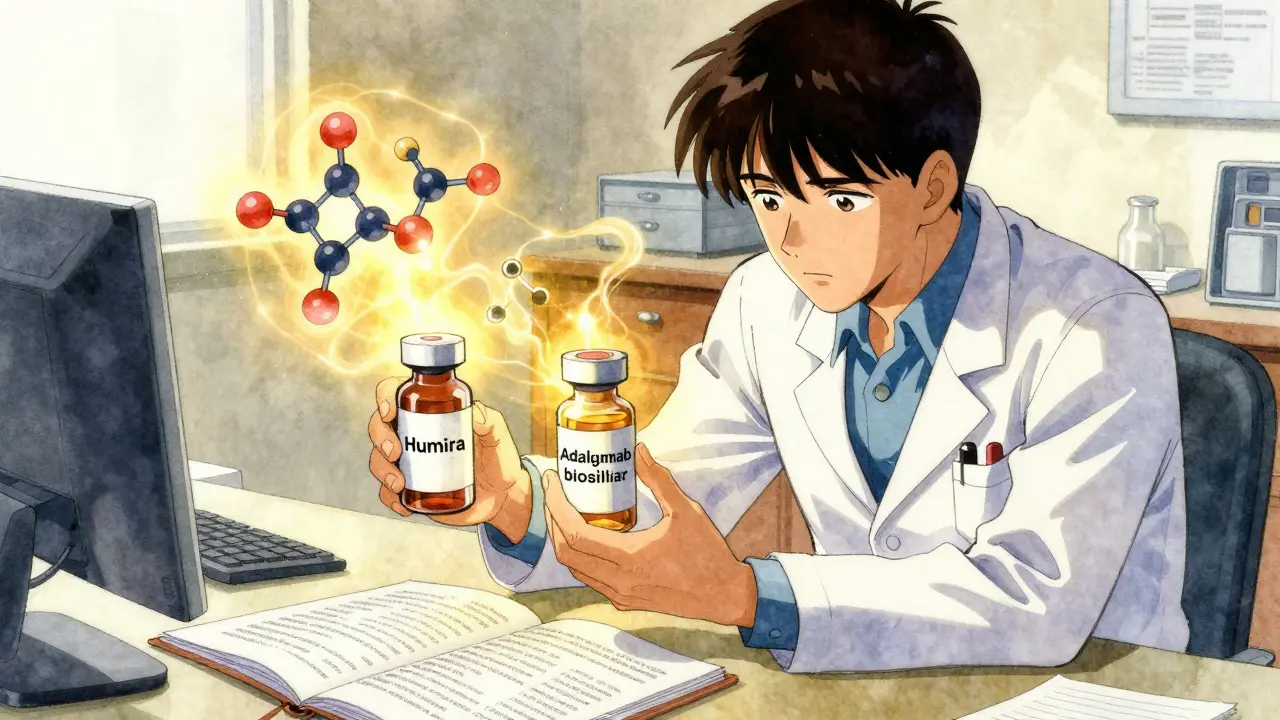
When a patient walks into your clinic with a prescription for a biologic like Humira or Enbrel, and you’re told the pharmacy can fill it with a biosimilar instead, do you know exactly what that means? If you’re like many U.S. providers, the answer might be no. Despite biosimilars being available for nearly a decade and saving billions in healthcare costs, provider education around these drugs remains inconsistent-and that’s putting patients at risk of confusion, delayed treatment, or even unnecessary fear.
What Exactly Is a Biosimilar?
A biosimilar isn’t a generic. That’s the first thing every provider needs to internalize. Generics are chemically identical copies of small-molecule drugs like metformin or lisinopril. Biosimilars, on the other hand, are complex biological products made from living cells-like antibodies, hormones, or fusion proteins. They’re not exact copies because biology doesn’t allow for perfect replication. But they don’t need to be.
The FDA requires biosimilars to show no clinically meaningful difference from their reference product in terms of safety, purity, and potency. That means the same dosing, same route of administration, same effectiveness, and same risk profile. Minor differences in inactive ingredients are allowed, but they can’t affect how the drug works in the body. For example, a biosimilar to adalimumab (Humira) must work just as well for rheumatoid arthritis, psoriasis, and Crohn’s disease-not just one of them.
Think of it like this: two different brands of insulin glargine might have slightly different preservatives or packaging, but they both lower blood sugar the same way. That’s biosimilarity. It’s not about being identical-it’s about being functionally equivalent.
Biosimilars vs Generics: The Key Differences
Here’s where confusion starts. Many providers assume biosimilars follow the same approval path as generics. They don’t. Here’s the breakdown:
- Generics: Must prove bioequivalence through one small study in healthy volunteers. No clinical trials needed for new indications.
- Biosimilars: Require extensive analytical testing, animal studies, and at least one clinical trial in humans-often involving hundreds of patients. The goal is to prove similarity across multiple dimensions: structure, function, immunogenicity, pharmacokinetics, and clinical outcomes.
And then there’s interchangeability. Not all biosimilars are interchangeable. Only those that have passed additional FDA testing-demonstrating that switching back and forth between the reference product and the biosimilar multiple times doesn’t increase safety risks or reduce effectiveness-are labeled as interchangeable. As of 2025, only about 10 of the 46 approved U.S. biosimilars have this designation. That’s critical because only interchangeable biosimilars can be substituted at the pharmacy without prescriber involvement, depending on state law.
Yet, a 2021 survey found that 63% of U.S. physicians couldn’t correctly identify this distinction. That’s not just a knowledge gap-it’s a patient safety risk.
Why Provider Education Is Lagging
It’s not for lack of resources. The FDA has published a free, comprehensive Teaching Resource Guide with 12 modules covering everything from manufacturing to immunogenicity. They’ve trained 147 medical schools, 134 pharmacy schools, and over 200 nursing programs. Yet, only 38% of U.S. physicians describe themselves as “extremely familiar” with the FDA’s definition of biosimilarity.
Why? Because education isn’t happening where it matters most: at the point of care. Most providers learned about drugs in school a decade ago, and biosimilars weren’t on the radar then. Now, they’re being introduced in fast-moving, high-stakes environments-oncology clinics, rheumatology practices, endocrinology offices-without structured training.
Studies show a clear link between education and confidence. In a 2017 study of oncology staff, providers who went through 12 training sessions over four months went from 40.1% confidence in biosimilar efficacy to 92%. That’s not a small jump-it’s transformative.
Meanwhile, younger providers-those under 40-are 40% less familiar with biosimilars than their more experienced colleagues. That’s alarming. If new doctors aren’t being trained properly now, the knowledge gap will widen.

Who’s Leading in Adoption? Who’s Falling Behind?
Adoption isn’t uniform. Rheumatologists are ahead of the curve-68% use biosimilars regularly. Oncologists aren’t far behind at 52%. But endocrinologists? Only 29%. And yet, insulin biosimilars have been available since 2015.
Why the gap? It comes down to three things: familiarity, fear, and workflow.
- Familiarity: Rheumatologists and oncologists have been exposed to biosimilars longer. They’ve seen data from Europe, where biosimilars have been used for over a decade with strong safety records.
- Fear: Endocrinologists worry about switching insulin-especially in elderly or diabetic patients with complex regimens. They fear hypoglycemia or loss of glycemic control. But real-world data from Sweden and Germany show no increased risk.
- Workflow: Many EHR systems don’t distinguish between biosimilars and reference products. In 78% of U.S. hospitals, providers report difficulties documenting biosimilar use. If your system just says “adalimumab,” you can’t track whether the patient got Humira or a biosimilar. That breaks pharmacovigilance and makes it harder to report adverse events.
At UCSF Medical Center, pharmacist-led education cut prescribing hesitancy from 58% to 12% in six months. How? They didn’t just hand out pamphlets. They held monthly case reviews, created quick-reference cards for common biosimilars, and integrated biosimilar tracking into the EHR. Simple, targeted, and practical.
Interchangeability and State Laws: What You Need to Know
Even if a biosimilar is FDA-approved as interchangeable, that doesn’t mean it can be automatically substituted. That decision rests with state law. As of 2025, 42 states have passed substitution laws-but they vary wildly.
- 12 states require immediate prescriber notification when substitution occurs.
- 24 states allow substitution with a 7-day notice to the prescriber.
- 6 states have no notification requirement at all.
And here’s the kicker: only interchangeable biosimilars can be substituted at the pharmacy without a new prescription. If a patient walks in with a prescription for “adalimumab,” and the pharmacy dispenses an interchangeable biosimilar, they can do it without calling you. But if it’s a non-interchangeable biosimilar? They must contact you first.
That means you need to know: Is this biosimilar interchangeable? Does my state require notification? Does my patient’s insurance cover it? If you don’t know the answer to those questions, you’re flying blind.

Immunogenicity: The Biggest Misconception
One of the most persistent myths is that biosimilars cause more immune reactions than the original biologic. That’s not true.
The FDA requires manufacturers to demonstrate that the immunogenicity profile of a biosimilar is comparable to the reference product. That means similar rates of anti-drug antibodies, similar rates of infusion reactions, and similar rates of loss of response over time.
Studies tracking patients for up to five years show no difference in immune-related adverse events between biosimilars and originators. In fact, the European experience shows lower rates of immunogenicity with biosimilars in some cases-likely because they’re manufactured under stricter quality controls in newer facilities.
Still, 57% of U.S. providers express concern about using biosimilars for indications not directly studied in clinical trials. That’s called “extrapolation.” And it’s not just allowed-it’s standard practice. If a biosimilar works in rheumatoid arthritis and the manufacturer can show it’s highly similar to the reference product, the FDA can approve it for psoriasis, Crohn’s, or ankylosing spondylitis-even if no clinical trial was done in those conditions. Why? Because the mechanism of action is the same. The same logic applies to generics: if you prove bioequivalence for hypertension, you don’t need separate trials for heart failure.
How to Get Educated (And What to Do Today)
You don’t need a six-month course. Start here:
- Go to the FDA’s Biosimilar Education Page. Download their Teaching Resource Guide. It’s free, peer-reviewed, and updated annually. Spend 90 minutes on Modules 1, 4, and 7.
- Ask your pharmacy. When a biosimilar is dispensed, ask: Is it interchangeable? Is it approved for this indication? What’s the product name?
- Update your EHR. Work with your IT team to create a dropdown for biosimilars in your prescribing system. Don’t let them all roll into one generic “adalimumab” field.
- Talk to your patients. Don’t assume they know what a biosimilar is. Use simple language: “This is a highly similar version of the drug you’ve been taking. It’s been tested just as rigorously and works the same way.”
- Join a local learning group. Many hospitals now have pharmacist-led biosimilar education sessions. Attend one. Bring your team.
The savings are real. Medicare Part B biosimilars cost 28% less than reference products. Over the next decade, biosimilars could save the U.S. healthcare system $150 billion. But none of that matters if providers don’t understand how to use them.
What’s Next?
By 2025, the Association of American Medical Colleges plans to integrate biosimilar education into 95% of medical school curricula. That’s progress. But we can’t wait for the next generation. We need to educate the providers who are prescribing today.
Every time you choose a biosimilar over a reference product, you’re not just saving money-you’re making a life-saving therapy more accessible. But that only works if you know what you’re prescribing.
Start small. Learn one biosimilar this week. Talk to one patient about it. Update one EHR field. That’s how change happens.
Are biosimilars the same as generic drugs?
No. Generics are chemically identical copies of small-molecule drugs and only need to prove bioequivalence in one study. Biosimilars are complex biological products made from living cells. They require extensive analytical testing, animal studies, and at least one clinical trial to prove they are highly similar to the reference product with no clinically meaningful differences in safety or effectiveness.
Can biosimilars be automatically substituted at the pharmacy?
Only if they’re designated as “interchangeable” by the FDA and your state allows substitution. Not all biosimilars are interchangeable. Only about 10 of the 46 approved in the U.S. have this status. Even then, state laws vary-some require prescriber notification, others don’t. Always check your state’s rules and the product label.
Do biosimilars cause more immune reactions than the original biologic?
No. The FDA requires biosimilars to demonstrate comparable immunogenicity profiles to the reference product. Real-world data from Europe and the U.S. show no increased risk of anti-drug antibodies, infusion reactions, or loss of response. In some cases, newer manufacturing processes for biosimilars may even reduce immunogenicity.
Why are some doctors hesitant to use biosimilars?
Common concerns include fear of reduced effectiveness, uncertainty about extrapolation (using a biosimilar for indications not directly studied), and EHR documentation challenges. Many providers weren’t trained on biosimilars during medical school. Studies show that after targeted education, provider confidence in biosimilars increases from under 40% to over 90%.
What’s the biggest barrier to biosimilar adoption?
The biggest barrier is lack of provider education-not cost or safety. While biosimilars are proven safe and cost 15-30% less, 63% of U.S. physicians can’t correctly explain how they differ from generics. EHR systems that don’t track biosimilars separately and inconsistent state substitution laws also contribute, but education is the foundation for all other progress.
How can I start using biosimilars confidently?
Begin by reviewing the FDA’s free Teaching Resource Guide. Focus on Modules 1 (What is a biosimilar?), 4 (Interchangeability), and 7 (Clinical Evidence). Talk to your pharmacy team about which biosimilars are available and whether they’re interchangeable. Update your EHR to distinguish biosimilars from reference products. Start with one drug class-like TNF inhibitors-and build from there. Educate your patients using simple, clear language.


Roshan Joy
January 12, 2026 AT 07:31Really appreciate this breakdown. I work in a clinic in Mumbai where biosimilars are becoming common, but even some senior docs still call them 'cheap generics'. This post nails the difference - biology isn’t Lego, you can’t just swap pieces and expect the same machine to run. Thanks for the clarity.
Michael Patterson
January 13, 2026 AT 04:17Ok so let me get this straight - biosimilars are like a slightly different version of a hand-knitted sweater made by a different artisan using the same pattern but maybe a different wool brand? And the FDA says it’s fine as long as it keeps you warm the same way? But then why does every pharmacist act like they’re handing out radioactive material? I’ve seen patients cry because they think they’re getting 'fake medicine'. And don’t even get me started on EHRs that just say 'adalimumab' like it’s a brand of toothpaste. Someone please fix this. Also typo: 'biosimilars' is spelled 'biosimilars' in the third paragraph. I know I’m being picky but this stuff matters.
Adewumi Gbotemi
January 14, 2026 AT 21:17Simple truth: if it works and costs less, why not use it? My cousin in Lagos got her rheumatoid arthritis treatment with a biosimilar. Same results. Half the price. No drama. Doctors here need to stop overcomplicating things. Patients just want to feel better.
Matthew Miller
January 15, 2026 AT 00:31This is a glorified marketing pamphlet dressed up as medical education. You say biosimilars are 'not clinically meaningful differences' - but you ignore the fact that 30% of real-world studies show higher immunogenicity in some populations. And you gloss over how pharma companies use biosimilars to lock in patients on expensive contracts with payers. This isn’t about education - it’s about profit. Wake up.
Madhav Malhotra
January 16, 2026 AT 07:31Love how you broke this down. In India, we’ve been using biosimilars for TNF inhibitors since 2018 - and honestly, the outcomes are just as good. Maybe the fear comes from not having enough local data? We need more Indian studies, more local training. But yeah, the science is solid. Keep spreading the word!
Vincent Clarizio
January 18, 2026 AT 00:24Let’s be real - the entire system is broken. We’re told to prescribe biosimilars to save money, but then we’re stuck with EHRs that can’t tell the difference between Humira and its copy. We’re told they’re equivalent, but then insurance companies only cover them if we jump through 17 hoops. And the FDA? They approve them like they’re approving a new flavor of yogurt. Meanwhile, patients are getting confused, scared, and sometimes outright refused care because the pharmacy says 'it’s interchangeable' but the doctor didn’t sign off. This isn’t progress. It’s chaos wrapped in a PowerPoint slide. And you call this 'education'? Please. We need systemic overhaul, not a 90-minute PDF.
Alex Smith
January 18, 2026 AT 21:20So let me get this straight - you’re telling me that a drug made in a lab in Korea, using living cells, is 'functionally equivalent' to one made in Switzerland, and we’re supposed to just… trust that? And no one’s asking why the original biologics cost $20K a year while the biosimilar is $14K? Who’s really saving money here? The patient? Or the middlemen? And why are we still pretending this isn’t a corporate play? Also, 'extrapolation'? That’s just a fancy word for 'we didn’t test it, but we’re gonna sell it anyway'. Classic.
Priscilla Kraft
January 19, 2026 AT 07:37As a nurse practitioner in rural Ohio, I’ve seen firsthand how scared patients get when they hear 'biosimilar'. I use the insulin analogy - 'It’s like two different brands of battery - same voltage, same life, just different packaging.' And guess what? They get it. I also keep a little card in my pocket with the top 5 biosimilars and their interchangeability status. Simple. Practical. I wish every provider had one. Also, the FDA guide? Lifesaver. 🙏
Sean Feng
January 20, 2026 AT 01:19Biosimilars are fine. Just use them. Stop writing essays. The system is broken. Fix it. Done.
Sam Davies
January 20, 2026 AT 16:21Oh look, another ‘educational’ piece that assumes providers are just too stupid to understand science. How quaint. The real issue? Pharma won’t let you know the biosimilar’s manufacturing process because it’s proprietary. So how can you really prove similarity? It’s all smoke and mirrors wrapped in FDA jargon. And don’t get me started on the 7-day notification laws - because nothing says ‘patient autonomy’ like a bureaucratic delay. I mean, really. We’re in 2025 and we’re still treating patients like lab rats with paperwork.
Christian Basel
January 22, 2026 AT 04:12The immunogenicity data is statistically insignificant in phase 3 trials. Real-world data shows no difference in ADA formation, but you’re ignoring the confounding variables: concomitant immunosuppressants, patient comorbidities, and assay variability. Also, the pharmacokinetic equivalence thresholds are set at 80-125%, which is the same as generics - but the biological complexity makes this a false equivalency. You need to adjust for Cmax and AUC0-inf with population PK modeling, not just non-inferiority margins. Otherwise, you’re just repeating industry talking points.
Priya Patel
January 23, 2026 AT 11:30I’m a diabetic and switched to an insulin biosimilar last year. My A1c didn’t budge. My co-pay dropped from $180 to $45. My nurse showed me the FDA page and said ‘it’s like swapping your iPhone charger - same plug, different brand.’ I didn’t even notice. Why is this so hard for docs to explain? 😊
Jennifer Littler
January 24, 2026 AT 04:35While I appreciate the intent behind this piece, the framing still centers provider knowledge as the primary barrier - ignoring systemic issues like payer restrictions, formulary tiering, and the fact that many biosimilars are only available in single-dose vials, which are incompatible with auto-injector devices used by elderly patients. Until we fix logistics, not just education, we’re just rearranging deck chairs on the Titanic.
Jason Shriner
January 24, 2026 AT 18:44So… we’re supposed to trust a drug that’s ‘not identical’ but ‘not meaningfully different’? That’s not science. That’s philosophy. And now you want me to switch my patients back and forth between biosimilars and originals like they’re playing musical chairs? What if one triggers a flare? Who’s liable? The pharmacist? The pharmacy? The FDA? Or me? I’m just the guy holding the pen. And you’re asking me to be a biologist, a lawyer, and a financial advisor all at once. Cool. I’ll just add ‘biosimilar wizard’ to my resume. 😒
Alfred Schmidt
January 25, 2026 AT 14:58THIS IS A DISASTER. I had a patient last week who developed a rash after switching to a biosimilar - and guess what? The pharmacy didn’t even log the product name in the EHR! So now I can’t even tell if it was the biosimilar or the original! And you think a PDF is going to fix this?! We need mandatory CME credits. We need barcode scanning. We need federal oversight. We need a national biosimilar registry. And we need to fire every pharmacist who doesn’t know the difference between interchangeable and non-interchangeable! This isn’t just negligence - it’s criminal! 😡