
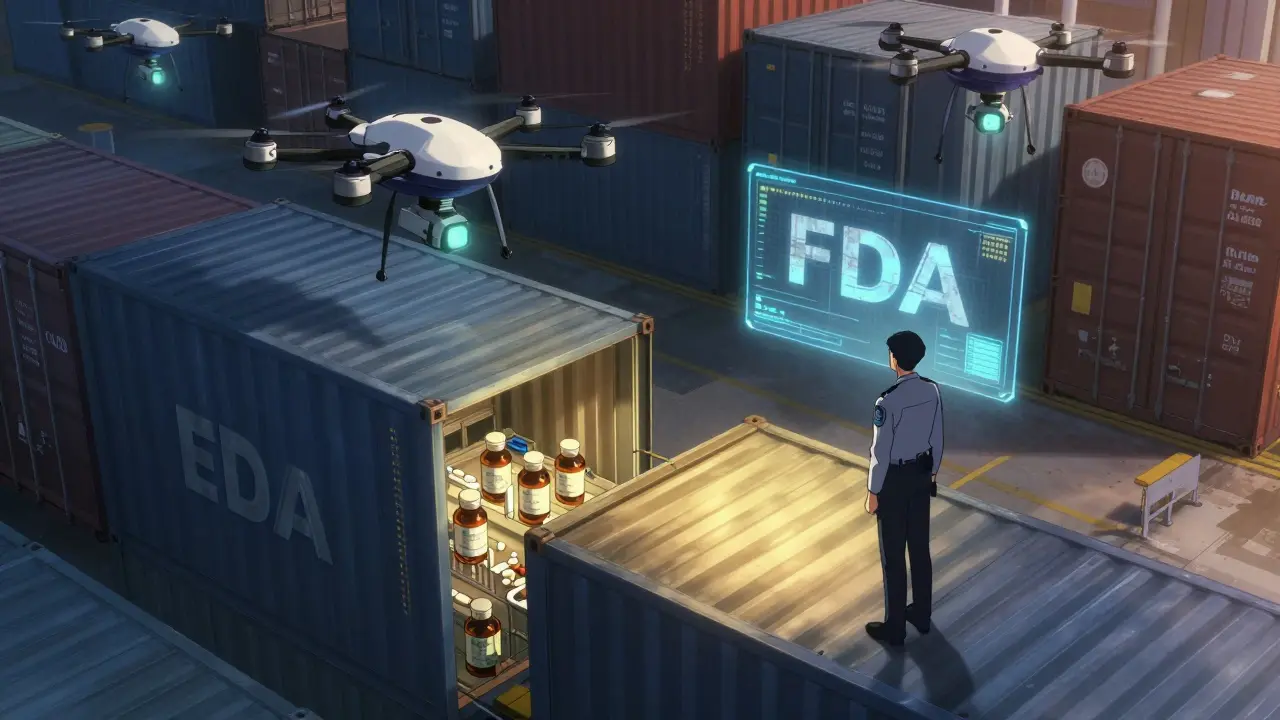
Every pill, injection, or capsule that enters the U.S. from abroad goes through a strict screening process
The U.S. Food and Drug Administration (FDA) doesn’t just check drugs made in the U.S. - it watches every single pharmaceutical shipment coming from overseas. That includes everything from common antibiotics shipped from India to heart medications from Germany and insulin produced in Switzerland. With over 100 million drug shipments entering the country each year, the FDA can’t inspect them all physically. Instead, it uses a smart, risk-based system that catches problems before they reach pharmacies and hospitals.
Here’s how it actually works - from the moment a shipment leaves a foreign factory to the final decision on whether it’s allowed into the U.S.
The five-step FDA import inspection process
The FDA’s import system runs like a well-oiled machine, with five clear stages:
- Entry Submission - The importer or customs broker files electronic paperwork through the FDA’s system. This includes the commercial invoice, bill of lading, and a formal declaration that the product meets U.S. standards.
- Entry Review - A computer system automatically scans over 98% of entries. It flags shipments based on risk: past violations, manufacturer history, product type, country of origin, and even the port of entry. About 15.7% of entries get flagged for deeper review.
- Examination and Sampling - If flagged, the shipment is held at the port. FDA inspectors may do a physical check, verify labeling matches FDA rules (21 CFR Part 201), or take samples for lab testing. Most samples are just 1-3 units per shipment, but those are enough to detect contamination, wrong ingredients, or fake packaging.
- Compliance Review - FDA checks if the product is from a registered facility, if the manufacturer has a history of violations, and if the product has proper approval (like an NDA or ANDA). If it’s missing any of these, the product is detained.
- Final Admissibility Decision - The FDA either releases the shipment or refuses it. In 2022, 14.3% of physically inspected drug shipments were detained. Of those, nearly 68% were permanently blocked from entering the U.S.
Who gets inspected - and who doesn’t?
Not all shipments are treated the same. The FDA uses a tiered system based on risk.
High-risk shipments include:
- Drugs from countries with a history of poor manufacturing (like certain facilities in India and China)
- Products previously caught for contamination (like the 2022 valsartan recall)
- Medications sold online without a prescription
- Products with incomplete or suspicious paperwork
These get targeted for physical inspection or sampling - even if they’re small.
Low-risk shipments - like those from trusted manufacturers with clean records - can move through faster. That’s where the Secure Supply Chain Pilot Program (SSCPP) comes in.
Launched in 2019, the SSCPP lets 27 top-tier manufacturers (as of late 2023) skip most inspections. Companies like Johnson & Johnson qualify by proving they have flawless quality control, real-time data tracking, and zero violations for at least three years. Their shipments clear in 24-48 hours instead of the usual 7-10 days. But there’s a catch: only five products per company can be approved under this program, and it’s not open to small or generic drug makers.
The end of the 0 loophole
Before October 2023, small packages under $800 - called “de minimis” shipments - were exempt from FDA review. That meant anyone could ship pills, supplements, or even pill presses directly to U.S. homes without any oversight.
That changed. In October 2023, the FDA and Customs and Border Protection shut down the loophole. Now, every FDA-regulated product - no matter the value - must be reviewed. This move was a direct response to the flood of counterfeit drugs, unapproved weight-loss pills, and fake ADHD medications entering through online sellers.
The result? The FDA now handles about 1.2 million import entries annually, and that number is expected to jump by 350,000 more because of the new rule. It’s a big burden, but it’s also the most effective way to stop dangerous products from slipping in.
Why some shipments get held - and how to avoid it
Most delays aren’t because the drug is unsafe. They’re because of paperwork mistakes.
Here are the top three reasons shipments get stuck:
- Incorrect product coding - Using the wrong Harmonized System (HS) code? That causes 28% of delays.
- Missing or expired facility registration - If the manufacturer’s U.S. facility isn’t registered with the FDA, the shipment is detained. This happens in 21% of cases.
- Labeling errors - Missing lot numbers, wrong dosage info, or no English labeling? That’s 19% of problems.
Importers who avoid these issues often work with experienced customs brokers or assign staff to handle FDA compliance full-time. Small biotech firms, in particular, struggle - many don’t have the resources to hire compliance experts. One startup founder on Reddit reported that since the $800 rule ended, their research samples now cost $285-$420 more per shipment and take 3-5 extra days to clear.
Pro tip: Establish a direct line with FDA reviewers at your port of entry. Companies that do this report 22-35% faster processing times.

The hidden gaps in the system
Despite its strengths, the FDA’s system isn’t perfect.
Here’s the reality:
- The FDA physically inspects only about 1.2% of all drug shipments. That means 98.8% rely on paper reviews and risk algorithms.
- Generic drug makers say they’re hit harder than brand-name companies. Teva Pharmaceuticals reported that 37% of their API shipments from certain Indian facilities were detained in early 2023 - even though they met all standards.
- The Government Accountability Office (GAO) found that only 4 of 17 performance metrics required by law have been fully tracked by the FDA.
- Counterfeit drugs still get through. The Partnership for Safe Medicines estimates $4.3 billion in fake medications entered the U.S. in 2022 - mostly before the de minimis rule change.
And here’s the biggest concern: the U.S. imports 88% of its active pharmaceutical ingredients (APIs). That means the safety of most medicines depends on factories overseas - many of which the FDA inspects only once every 2-5 years.
What’s next for FDA import inspections?
The FDA isn’t standing still. It’s rolling out new tools to get smarter and faster:
- AI-driven risk scoring - By 2025, the agency plans to improve its targeting accuracy by 25% using machine learning to predict which shipments are most likely to be violative.
- Blockchain pilots - Starting in early 2024, the FDA will test blockchain tech to track drug movement from factory to pharmacy - making it harder to swap or tamper with products.
- Expanding the SSCPP - The number of approved manufacturers will grow from 27 to 50 by mid-2024, and contract manufacturers will now be eligible.
- Global alignment - The FDA is working with the Pharmaceutical Inspection Co-operation Scheme (PIC/S) to harmonize inspections with Europe, Canada, and Japan, reducing duplicate audits.
These changes aim to cut clearance times by 30-40% while catching more bad products. But they’ll cost $187 million over five years - money the FDA says it needs to keep up with the growing volume of global drug trade.
What this means for you
If you’re a patient: The system is designed to protect you. The drugs you get from a U.S. pharmacy are far safer than those bought online from unknown sellers.
If you’re a pharmacy or distributor: Know your supplier’s FDA registration status. If they’re not registered or have an Import Alert, you’re at risk.
If you’re a small business importing research materials or specialty drugs: The rules are tougher now. Budget for delays. Use a customs broker with FDA experience. And never assume a small shipment will slip through - it won’t.
The bottom line: The FDA doesn’t have unlimited resources, but it’s using every tool it has to keep dangerous drugs out. The system isn’t flawless, but it’s the best in the world - ranked second globally by the World Health Organization, behind only Switzerland.
What you can do: Always buy medicines from licensed U.S. pharmacies. If you see a website selling drugs without a prescription, report it to the FDA’s MedWatch program. Your vigilance helps close the gaps the inspectors can’t reach.
Does the FDA inspect every drug shipment that enters the U.S.?
No, the FDA doesn’t physically inspect every shipment - there are over 100 million entries each year. Instead, it uses an electronic risk-based system to screen 98% of entries. Only about 1.2% of shipments are physically examined. High-risk shipments - based on manufacturer history, product type, or country of origin - are targeted for inspection.
What happens if a drug shipment is detained by the FDA?
If a shipment is detained, it’s held at the port until the FDA makes a decision. The importer can provide additional documentation, fix labeling issues, or request a re-inspection. If the problem can’t be resolved - like contamination, unapproved ingredients, or unregistered facilities - the product is refused entry and must be destroyed or returned to the country of origin.
Can I import prescription drugs from other countries for personal use?
The FDA generally doesn’t allow personal importation of prescription drugs from other countries, even if they’re legal there. There’s a limited exception for a three-month supply of a drug that’s not available in the U.S. - but only if it’s for a serious condition and there’s no U.S. alternative. Even then, the shipment can still be seized if it’s not clearly for personal use or if it’s counterfeit.
What is the Secure Supply Chain Pilot Program (SSCPP)?
The SSCPP is a voluntary program that lets top-tier manufacturers with perfect compliance records get their drugs cleared in 24-48 hours instead of 7-10 days. To qualify, a company must have no violations for three years, strong quality controls, and real-time supply chain tracking. Only 27 companies are in the program as of late 2023, and each can designate up to five products for fast-track clearance.
Why are generic drugs getting detained more often than brand-name drugs?
Generic drug manufacturers often source active ingredients from overseas facilities that have higher inspection failure rates. Many of these suppliers are smaller and lack the resources to maintain consistent quality. The FDA’s risk system flags these shipments more often. In Q2 2023, 37% of generic API shipments from certain Indian facilities were detained - even when the final product met standards.
How can I check if a drug manufacturer is FDA-registered?
Go to the FDA’s Drug Establishment Registered Online (DERO) database. Search by company name or facility location. If the facility isn’t listed, the drugs it produces can’t legally be imported into the U.S. Also check for Import Alerts - these are public notices that flag companies with repeated violations.


Janice Holmes
December 29, 2025 AT 06:39Alex Lopez
December 31, 2025 AT 01:53Liz Tanner
January 1, 2026 AT 04:04John Barron
January 1, 2026 AT 09:33Liz MENDOZA
January 2, 2026 AT 14:56Miriam Piro
January 3, 2026 AT 14:11Paula Alencar
January 3, 2026 AT 18:28James Bowers
January 5, 2026 AT 09:16Will Neitzer
January 5, 2026 AT 18:46Gerald Tardif
January 6, 2026 AT 13:46Babe Addict
January 8, 2026 AT 03:50Satyakki Bhattacharjee
January 8, 2026 AT 22:35Kishor Raibole
January 10, 2026 AT 18:05dean du plessis
January 12, 2026 AT 12:21Kylie Robson
January 13, 2026 AT 11:06