
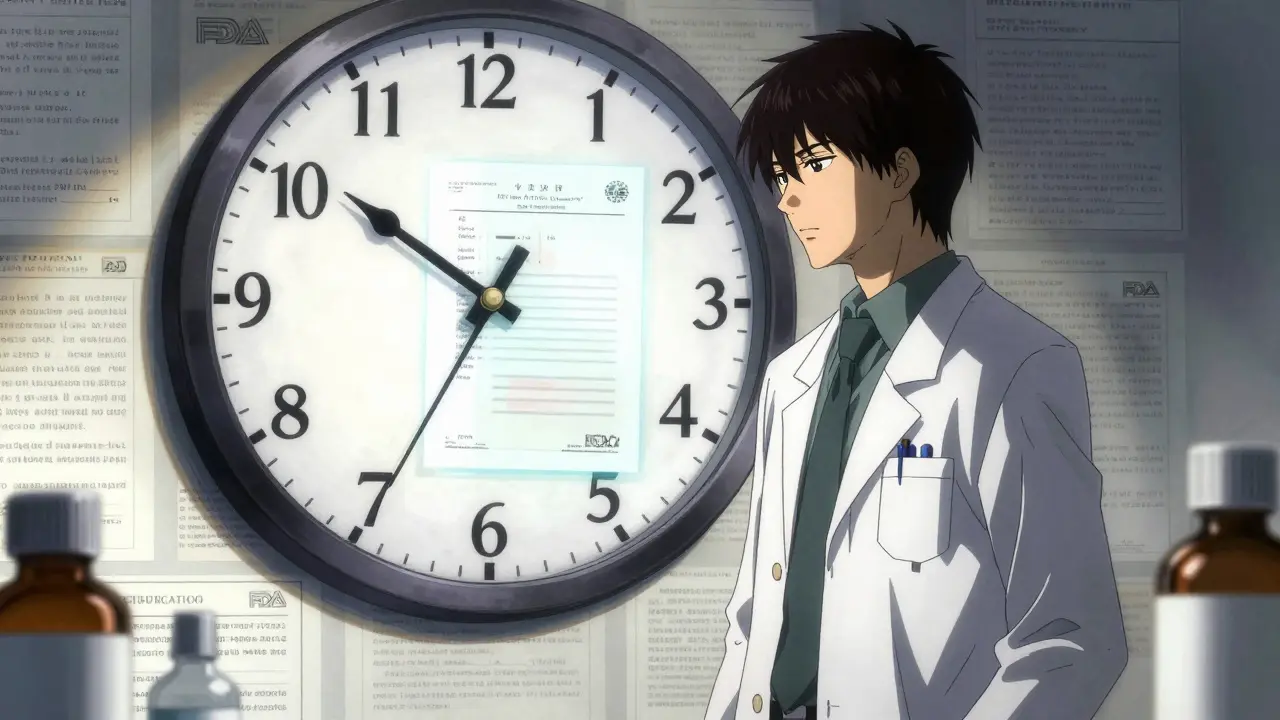
Most people don’t realize that the clock on a drug’s patent starts ticking the moment it’s filed - often years before it even reaches patients. By the time a new medicine gets FDA approval, it’s not uncommon for 7 to 9 years of its 20-year patent life to already be gone. That’s where patent term restoration comes in. It’s not a loophole. It’s a legal reset button built into U.S. law to make up for the time lost waiting for regulators to approve life-saving drugs.
How Patent Term Restoration Works
Patent term restoration (PTR), also called patent term extension (PTE), is governed by the Hatch-Waxman Act of 1984. This law was designed to balance two competing goals: letting generic drugs enter the market faster while giving innovator companies a fair shot at recouping their investment. Without PTR, companies would have little incentive to develop new drugs if they only had 10 or 11 years left to sell them after years of clinical trials.The extension isn’t automatic. It’s calculated using a strict formula: half the time spent in clinical testing (from IND submission to NDA submission) plus the entire FDA review period (from NDA submission to approval). But there’s a hard cap - no more than five years can be added. And even then, the total time a drug can be under patent protection after approval can’t exceed 14 years.
For example, if a drug took 6 years to complete clinical trials and 3 years to get FDA approval, the calculation would be: 3 years (half of 6) + 3 years (review period) = 6 years of potential extension. But since the cap is 5 years, the company gets 5. That means if the patent originally had 12 years left when approval came, it now has 17 years total - five more than it started with.
Who Can Apply and What’s Covered
Only certain products qualify. The law applies to human drugs, medical devices, food additives, color additives, and animal drugs. But not every patent gets extended - only one patent per product can be restored, even if the company holds multiple patents covering the same drug. That’s why pharmaceutical companies carefully choose which patent to extend. They pick the one with the broadest claims, the strongest enforcement potential, or the one that’s about to expire first.Here’s the catch: the extension only covers uses that were actually approved by the FDA. If your patent claims a drug for treating cancer, heart disease, and diabetes, but the FDA only approved it for cancer, then your extended patent only protects the cancer use. You can’t stop generics from making the drug for other off-label uses.
This rule was confirmed in the 1996 case Merck & Co. v. Kessler. The court made it clear: PTR doesn’t expand the scope of the patent. It just buys back time - on the exact same terms.
Timing Is Everything
The application window is narrow and unforgiving. Companies have just 60 days after FDA approval to file for PTR with the FDA. Miss that deadline, and you lose the chance forever. According to FDA data, 37% of denied PTR applications were because of late filings. That’s not a technical error - it’s a paperwork failure.After the FDA reviews the application, it publishes its proposed extension period in the Federal Register. That triggers a 60-day period where competitors or third parties can challenge the calculation. They might argue the company didn’t act with “due diligence” during testing - like delaying patient enrollment or ignoring safety signals. If the FDA agrees, the extension gets cut. One biotech firm lost 12 of its 14 months of requested extension because clinical trial recruitment dragged on for months without justification.
Then, the FDA sends its recommendation to the USPTO, which issues the actual patent extension. The whole process can take 6 to 12 months. And if you’re doing this for the first time? You’ve got a 42% chance of making a mistake on your first try, according to FDA internal reports.

Patent Term Restoration vs. Other Exclusivity Tools
PTR is not the only tool in the toolbox. There’s also:- Data exclusivity: 5 years for new chemical entities, 3 years for new clinical studies. This prevents generics from relying on your clinical data to get approval - but they can still make the drug as long as they run their own trials.
- Orphan drug exclusivity: 7 years for drugs treating rare diseases (under 200,000 patients in the U.S.).
- Patent Term Adjustment (PTA): This is different. PTA adds time for delays caused by the USPTO during patent prosecution - not the FDA during drug approval.
Here’s the key difference: PTR extends the actual patent. Data exclusivity doesn’t touch the patent at all - it’s a separate regulatory barrier. That means with PTR, you can still sue generics for infringement. With data exclusivity, you can’t stop them from making the drug - just from using your data to get approved.
According to the Congressional Research Service, about 70% of new drug approvals get PTR. But 100% get data exclusivity. So most drugs get both - but PTR is what really locks in long-term revenue.
Why It Matters Economically
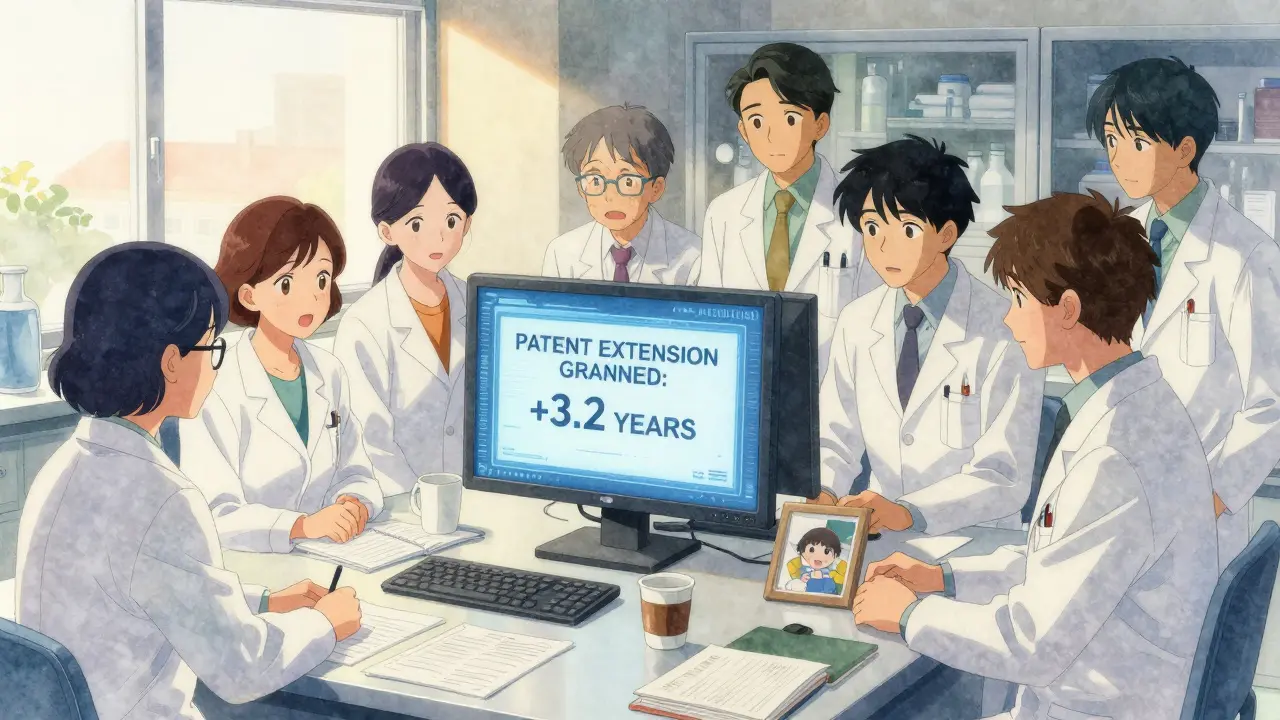
The numbers don’t lie. In 2022, 87% of the top 100 selling drugs in the U.S. relied on patent term restoration to maintain exclusivity. The average extension? 3.2 years. For a blockbuster drug making $2 billion a year, that’s an extra $6.4 billion in revenue.Dr. Robert Grabowski of Duke University found that PTR increases the net present value of drug development by 11-15%. That’s the difference between a project being profitable or getting shelved. The Congressional Budget Office estimates PTR extensions cost Medicare $5.2 billion a year by delaying generics. That’s why lawmakers keep trying to cap it - proposals like the Lower Drug Costs Now Act wanted to limit extensions to just 3 years. So far, those efforts haven’t passed.
But here’s the flip side: without PTR, PhRMA estimates the return on investment for new drugs would drop by 18%. That could mean fewer new cancer drugs, fewer treatments for rare diseases, and fewer breakthroughs overall.
Common Pitfalls and How to Avoid Them
Even big companies mess this up. Here are the top three reasons PTR applications get rejected:- Missing the 60-day deadline - Simple, but deadly. Set calendar alerts. Double-check FDA approval dates.
- Wrong patent selected - You can only extend one patent per product. Picking the wrong one means losing your best shot at protection. Work with attorneys who understand both patent claims and FDA approval labels.
- Failing to prove due diligence - If the FDA thinks you dragged your feet during trials, your extension gets slashed. Keep detailed logs of every trial site visit, every regulatory communication, every delay with a clear reason.
Companies like Pfizer and Johnson & Johnson have dedicated PTR teams - often lawyers with JDs and PhDs - who track every milestone. They use specialized software like Patexis PTR Calculator to avoid math errors. One study showed these tools cut calculation mistakes by 78%.
The Future of Patent Term Restoration
PTR is under pressure. Generic manufacturers and consumer advocates argue it delays affordable access. But the industry counters that without it, innovation would stall. The trend is clear: more PTR applications are being filed every year. Between 2015 and 2022, applications for drug-device combo products jumped 300%. Oncology and orphan drugs are the fastest-growing segments.As drug development gets longer - the average time from IND to approval is now 8.2 years - PTR will become even more critical. The FDA started requiring electronic filings in January 2023, cutting review times from 90 to 60 days. The USPTO also updated its guidelines in 2022 after the Amgen v. Sanofi Supreme Court decision, which clarified how broad patent claims are interpreted.
But legal challenges are coming. Critics are watching for whether PTR violates constitutional protections against monopolies. And with Medicare spending on branded drugs rising, political pressure to cap extensions will only grow.
For now, PTR remains a vital, if controversial, tool. It’s not about gaming the system. It’s about recognizing that the time it takes to get a drug approved isn’t the company’s fault - it’s the cost of doing business in a heavily regulated system. The law gives companies a chance to recover that lost time. But only if they play by the rules - and know exactly what those rules are.

Stuart Shield
January 5, 2026 AT 07:12Wow, this is one of those posts that makes you realize how much behind-the-scenes engineering goes into getting a pill from lab to pharmacy. The math on patent extension isn’t just legal-it’s economic survival for biotech startups. I never thought about how a delay in patient enrollment could cost a company years of exclusivity. Mind blown.
Susan Arlene
January 5, 2026 AT 17:04so like… the patent clock starts when you file, not when you sell? that’s wild. no wonder drugs cost so much. they’re literally racing against time while the fda takes forever
Mukesh Pareek
January 6, 2026 AT 06:19Patent term restoration is not a subsidy-it’s a calibrated recalibration of incentive structures under regulatory capture. The Hatch-Waxman Act represents a Pareto-optimal equilibrium between innovation externality and market access efficiency. Mischaracterizing it as a 'loophole' reflects a fundamental misunderstanding of pharmaceutical IP architecture.
Ashley S
January 6, 2026 AT 09:31So pharma gets a 5-year bonus just because the government is slow? That’s not fair. We pay for it in higher prices and delayed generics. This system is rigged.
Joann Absi
January 6, 2026 AT 22:34AMERICA BUILT THIS SYSTEM TO WIN 🇺🇸🔥 They don’t give you 5 extra years because they’re nice-they do it because if we don’t lead in innovation, CHINA WILL. And you know what? I’m proud of it. 💪💊 #MakePatentsGreatAgain
Indra Triawan
January 7, 2026 AT 05:06i read this and i just… cried? not because i’m emotional, but because i realize how many people are counting on these extensions. my aunt got her life back because of a drug that probably wouldn’t exist without ptr. it’s not about greed-it’s about hope.
Saylor Frye
January 8, 2026 AT 11:53Look, I get the math. But when your 'blockbuster' drug costs $500k a year and you extend the patent by 3 years to milk it… that’s not innovation. That’s rent-seeking with a PhD. The system rewards lawyers more than scientists.
Kiran Plaha
January 9, 2026 AT 10:10so if i understand right, they can only extend one patent per drug? that means companies have to pick which one to protect like choosing which kid to send to college. kinda sad, but smart. makes me wonder how many patents they bury just to keep options open
Jeane Hendrix
January 10, 2026 AT 20:39data exclusivity vs ptr… i always mixed these up. so ptr is the patent clock extension, data exclusivity is like a wall around your clinical trials? so generics can make the drug but can’t use your data to get approved? that’s actually kind of fair. it’s not blocking them, just making them work for it.
Pavan Vora
January 11, 2026 AT 01:16did you know that in india, we dont have ptr like this? our generic makers jump in as soon as the patent expires. but we also dont have 100 billion dollar drug companies. its a trade off. we get cheap meds, you get new ones. both sides have their pain.
Matt Beck
January 12, 2026 AT 17:08so… if you miss the 60-day window? you’re just… screwed? 😭 no second chances? no grace period? no ‘oops i was on vacation’? that’s brutal. someone’s gotta get fired over that. imagine spending 12 years on a drug and losing it because of a missed deadline…
Lily Lilyy
January 13, 2026 AT 23:50This is why we need to celebrate the scientists and lawyers who make sure life-saving medicines reach us. It’s not easy. It’s not quick. But when it works? It changes everything. Thank you to everyone who plays by the rules to bring hope to millions.