
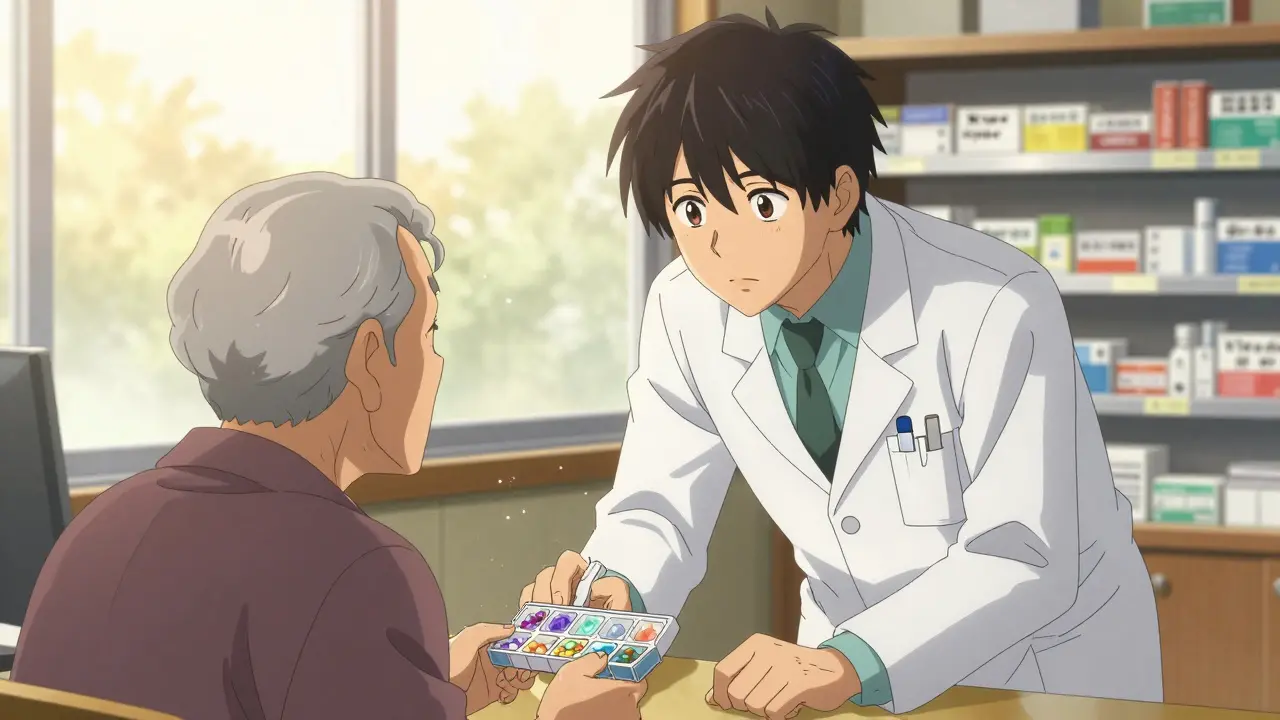
More than half of people with chronic illnesses don’t take their medications as directed. It’s not because they’re lazy or forgetful-it’s often because the system is stacked against them. High copays, confusing schedules, side effects they don’t understand, or simply not knowing why the pill matters. And yet, this isn’t just a personal struggle. It’s a $300 billion problem for the U.S. healthcare system every year. Medication adherence isn’t a soft issue-it’s a life-or-death one.
Why Pharmacists Are the Missing Link
Most patients see their doctor once or twice a year. They fill prescriptions at the pharmacy every few weeks. That’s where the real connection happens. Pharmacists are the only healthcare providers who see patients more often than doctors do-four to six times more, on average. They’re the ones who notice when a prescription isn’t refilled. They’re the ones who hear the sigh when a patient says, “I can’t afford this.” They’re the ones who can actually do something about it. Unlike doctors focused on diagnosis or nurses managing care coordination, pharmacists have one job: make sure the medicine works. And that means understanding not just the drug, but the person taking it.What Actually Works: Evidence-Based Strategies
Pharmacists don’t guess. They use proven methods backed by data from over 1,200 studies. Here’s what works:- One-on-one counseling-not a 30-second chat at the pickup window, but a 15- to 20-minute conversation. A 2024 study found patients who got this kind of time with their pharmacist were 45% more likely to keep their blood pressure under control.
- Medication synchronization-getting all prescriptions on the same refill schedule. One Veterans Affairs study showed this cut pharmacy visits from five per month to just two. Less hassle, fewer missed doses.
- Cost barrier solutions-68% of adherence programs focus here. Pharmacists connect patients with patient assistance programs, generic alternatives, or manufacturer coupons. One Reddit user shared how their CVS pharmacist found a $0 copay option for their blood pressure med-after eight months of non-adherence.
- Follow-up calls-23 studies show reminder calls improve refill rates. But they only work if they’re empathetic. A patient on Trustpilot complained when calls felt like guilt trips instead of support.
- Depression screening-one in three people with chronic illness also struggle with depression. Pharmacists now use simple tools like PHQ-2 and PHQ-9 to spot it. If a patient isn’t taking meds, it might not be about the pill-it’s about the pain.
Where It Makes the Biggest Difference
Not every patient needs the same help. The strongest results come in three areas:- Complex regimens-people taking five or more medications daily. These patients see up to a 37% improvement in adherence when pharmacists simplify schedules and explain interactions.
- After hospital discharge-patients leaving the hospital are at high risk. One study showed pharmacist-led follow-ups within 7 days cut readmissions by 22%.
- Mental health conditions-antidepressants and antipsychotics often get stopped because of side effects. Pharmacists who build trust help patients stick with them. One study found refill rates jumped 30% after structured counseling.
But it doesn’t work as well for people with severe dementia or cognitive decline. In those cases, adherence only improved by 4.2%-compared to 12.7% for those with normal thinking. That’s a key limit. Pharmacists can’t fix what they can’t reach.

What’s Holding It Back
The science is clear. The results are strong. So why isn’t every pharmacy doing this?- Time-a 20-minute counseling session takes time. Most pharmacists are stretched thin. One survey found 63% say documentation eats up too much of their day.
- Pay-only 28 states require insurance to reimburse pharmacists for medication therapy management (MTM). In the rest, it’s a cost the pharmacy absorbs. That’s why 38% of programs have no long-term funding.
- Training-not every pharmacist knows how to do motivational interviewing. It’s not about telling. It’s about listening. A 87-hour certification program exists, but only 41% of community pharmacists have taken it.
Some pharmacies try to cut corners. They send automated texts instead of talking. They track refills with apps but never ask why someone stopped. That’s not adherence support. That’s surveillance.
Real Results, Real Numbers
The data doesn’t lie:- Diabetes: Adherence improved by 4.0% in pharmacist-led programs. Control rates rose. Hospital visits dropped.
- Hypertension: Adherence went up 6.3%. That’s 30-45% better blood pressure control.
- Cholesterol: A 6.1% increase in adherence. Statin use went up. Heart attacks went down.
A 2024 study of over 1.2 million patients found pharmacist interventions saved $109 per diabetic patient, $122 per hypertensive patient, and $75 per hyperlipidemia patient. That’s $63 million in savings across just three conditions in two years.
And the return on investment? Harvard economist Dr. David Cutler says every $1 spent on pharmacist adherence services saves $7.43 in avoided hospital stays, ER visits, and complications.
The Future: Blended, Not Either/Or
Digital tools-apps, reminders, smart pillboxes-are growing fast. But they’re not enough. A 2023 review found blended programs-pharmacist + app-were 22% more effective than either alone.Pharmacists are the human layer. Apps can remind. But only a person can ask, “What’s making this hard for you?” and then act on the answer.
The CDC now recommends pharmacist-led interventions for cardiovascular disease. CMS expanded Medicare reimbursement in 2023. The National Pharmacist Adherence Collaborative launched in 2024 with 12 major pharmacy chains. And 92 Fortune 500 companies now include these services in employee health plans.
This isn’t a trend. It’s a transformation. The pharmacy counter is becoming a care hub. And pharmacists? They’re stepping into the role they’ve always been trained for-patient advocates.
What Needs to Change
If this approach is going to reach everyone who needs it, three things must happen:- Reimbursement must expand-all 50 states need MTM payment parity. No more asking pharmacists to work for free.
- Documentation must get easier-EHR templates built for pharmacists, not doctors, can cut charting time by a third.
- Training must be standard-motivational interviewing should be required in pharmacy school, not optional.
Medication adherence isn’t about compliance. It’s about connection. And pharmacists, with their access, expertise, and trust, are the ones who can build it.
Why do so many people stop taking their medications?
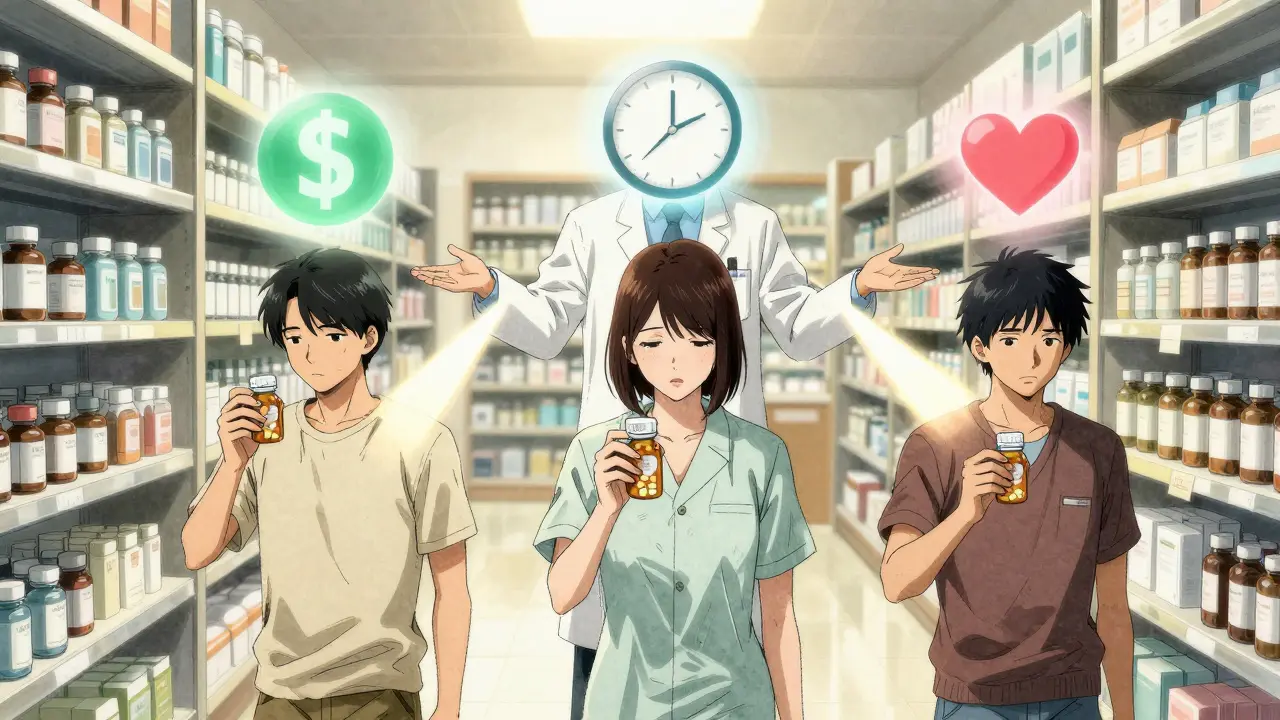
People stop for many reasons-not because they’re careless. The most common ones are cost (68% of cases), confusion about how or when to take pills (57%), side effects they don’t know how to manage (49%), and not understanding why the medicine matters (38%). Sometimes it’s depression, forgetfulness, or fear. Pharmacists are trained to uncover the real reason behind missed doses, not just assume it’s non-compliance.
Can pharmacists really change patient behavior?
Yes-when they’re given the time and tools. Studies show pharmacist-led interventions improve adherence by 4% to 6.3% across major chronic conditions like diabetes, hypertension, and high cholesterol. That may sound small, but it translates to 30-45% higher rates of disease control. One study found patients who got personalized counseling were 69% more likely to stick to their regimen than those who didn’t.
Do pharmacist interventions cost more than apps or automated systems?
Yes, initially. A full pharmacist-led program costs $125-$175 per patient per year, while app-based tools run $25-$50. But apps can’t negotiate copays, screen for depression, or explain drug interactions. When you add in avoided hospitalizations and ER visits, pharmacist services save $7.43 for every $1 spent. Digital tools are helpful-but they’re not replacements.
Are all pharmacists trained to help with medication adherence?
No. While all pharmacists learn drug science, only 41% have completed formal training in motivational interviewing or medication therapy management (MTM). Certification programs exist through the American Pharmacists Association, but they’re not required. That’s changing-2024’s updated practice framework now recommends MTM as standard for all community pharmacists.
How can I find a pharmacist who helps with adherence?
Ask if the pharmacy offers Medication Therapy Management (MTM) services. Most major chains (CVS, Walgreens, Rite Aid) and VA hospitals now provide this. Look for signs like “Free Medication Review” or “Personalized Pill Scheduling.” If they offer a one-on-one session-no rush, no pressure-that’s a good sign. You can also ask your doctor for a referral to a pharmacist with MTM certification.

Grace Kusta Nasralla
March 23, 2026 AT 13:26Pharmacists don't just refill. They listen. And sometimes, that's the only medicine left.
Korn Deno
March 24, 2026 AT 08:05Aaron Sims
March 25, 2026 AT 15:44Let me guess. Next you'll tell me nurses should get paid like surgeons and doctors should be on minimum wage. This is why America's healthcare is a joke. You're turning pharmacists into therapists while ignoring the real problem: drug prices are set by CEOs who don't take insulin.
Also. I've had 3 different pharmacists try to sell me CBD for my blood pressure. One of them said it was 'better than lisinopril'. So no. I don't trust your 'evidence-based strategies'.
Stephen Alabi
March 26, 2026 AT 12:18Agbogla Bischof
March 28, 2026 AT 11:24So yes, this works. But don't romanticize it. The real hero is the pharmacist who works 14 hours and gets paid $200/month. And yes, we still have 60% non-adherence. Because no amount of counseling fixes hunger.
Pat Fur
March 30, 2026 AT 09:25My grandma’s pharmacist? She called her every week. Just to check in. Not about refills. About how her cat died. About how her daughter moved away. That’s not healthcare. That’s humanity.
Anil Arekar
March 30, 2026 AT 11:53Elaine Parra
March 30, 2026 AT 12:29Meanwhile, the guy who actually makes the pills? He's getting sued for $10 billion. The system doesn't need more people doing more jobs. It needs fewer people doing fewer things. And stop pretending this is about 'connection'. It's about control.
Natasha Rodríguez Lara
March 30, 2026 AT 19:06This isn't policy. It's just… being there. Sometimes that's enough.
Chris Crosson
March 31, 2026 AT 07:10Real counseling? That’s risky. That’s vulnerable. That’s human. And that’s why most won’t do it-even if they can.
Linda Foster
April 1, 2026 AT 03:47Amber Gray
April 2, 2026 AT 05:27