
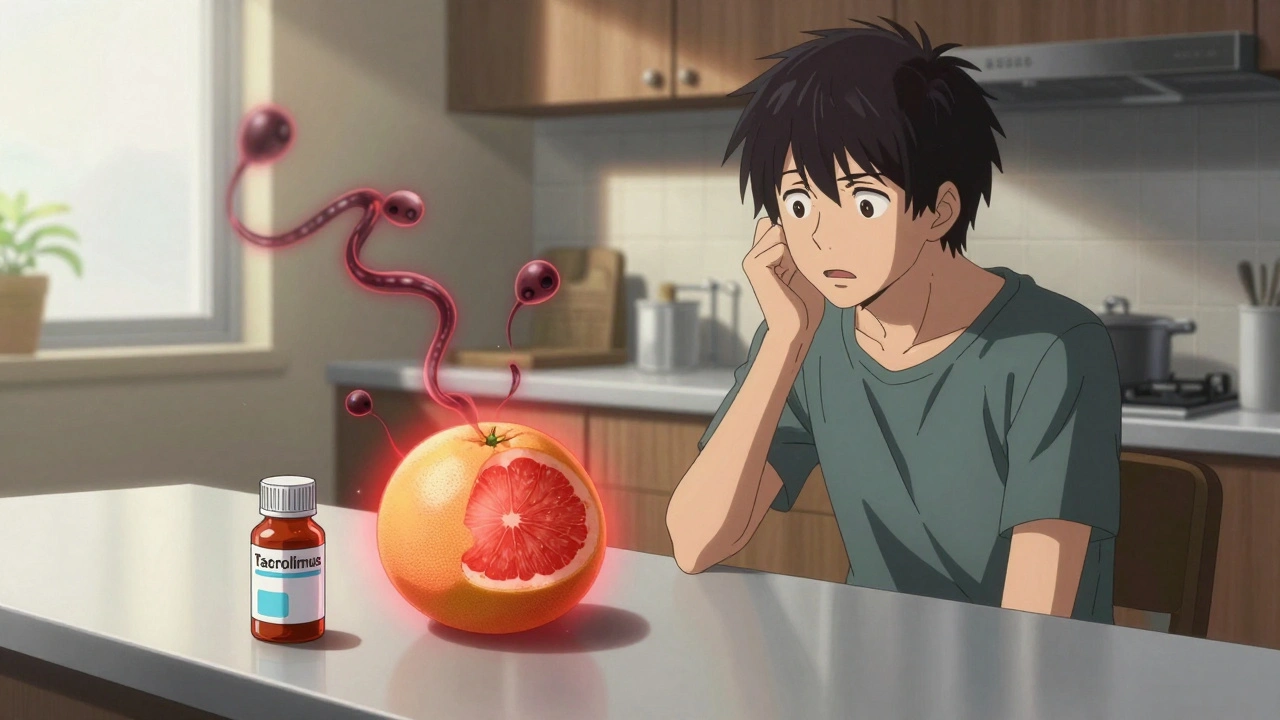
One glass of grapefruit juice can be harmless for most people. But if you’re taking an immunosuppressant after a transplant, that same glass could send your drug levels soaring into dangerous territory-fast. This isn’t a myth. It’s not a warning on a label you can ignore. It’s a well-documented, life-threatening interaction that’s been proven in labs, hospitals, and real patient stories for over 30 years.
Why Grapefruit Changes How Your Medication Works
Grapefruit doesn’t just mix with your medicine. It changes how your body processes it. The problem lies in a group of chemicals called furanocoumarins, found in grapefruit, pomelo, and Seville oranges. These compounds attack an enzyme in your gut called CYP3A4, which normally breaks down about half of the medications you swallow before they even reach your bloodstream.When CYP3A4 is blocked, your body can’t filter out the drug the way it should. Instead of 30% of your tacrolimus or cyclosporine making it into your blood, suddenly 60%, 80%, or even 100% gets absorbed. That’s not a small bump. That’s a spike. And for drugs with a narrow therapeutic window-where the difference between a helpful dose and a toxic one is tiny-that’s extremely dangerous.
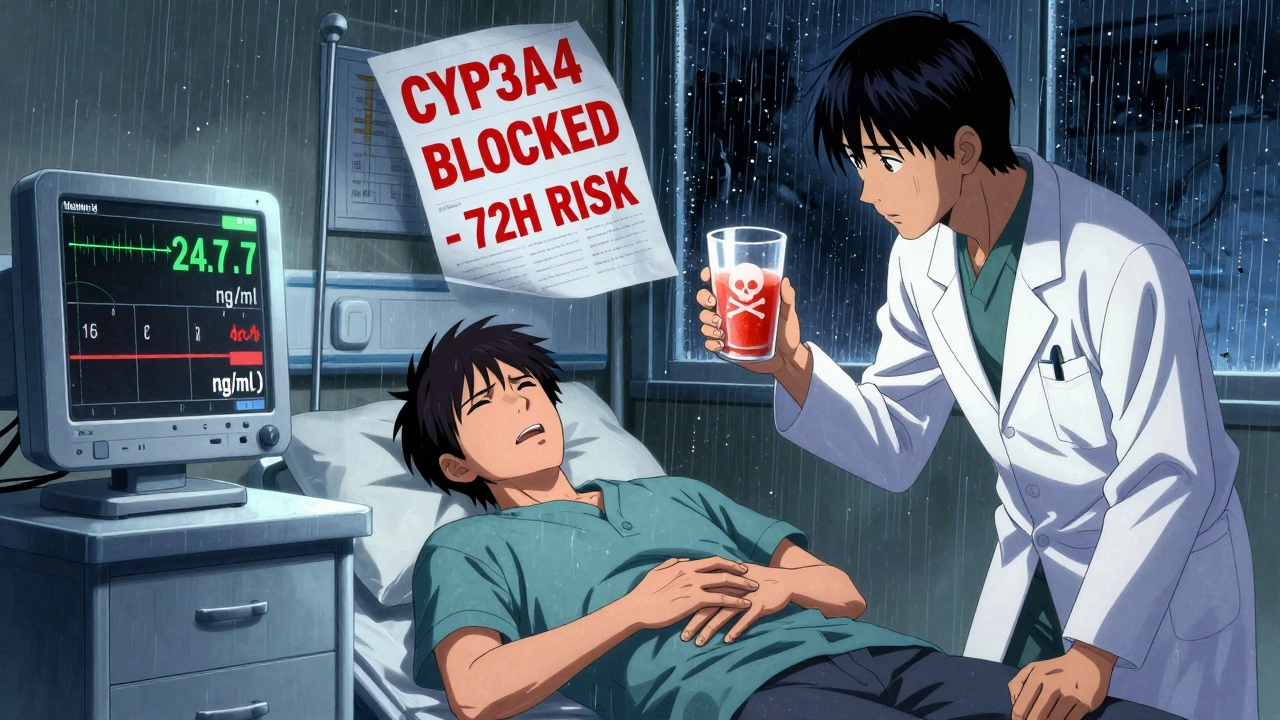
The effect isn’t temporary. Furanocoumarins bind to the enzyme permanently. Your body has to grow new enzymes to replace the ones destroyed. That takes time. Studies show that even 72 hours after drinking grapefruit juice, CYP3A4 activity is still reduced by more than 20%. So, if you have a glass on Monday, you’re still at risk on Thursday.
Which Immunosuppressants Are at Risk?
Not all immunosuppressants react the same way. But the ones that do are critical to transplant survival. The big three are:- Cyclosporine (Sandimmune, Neoral): Blood levels can jump 50-100% after grapefruit consumption.
- Tacrolimus (Prograf, Envarsus XR, Astagraf XL): Levels increase by 30-50%, sometimes more.
- Sirolimus (Rapamune): One study showed levels rising by 200-300%.
These drugs are all metabolized by CYP3A4, have low bioavailability (meaning your body absorbs only a small portion normally), and have a narrow therapeutic index. That means if your blood level goes from 10 ng/mL to 25 ng/mL, you’re not just getting more benefit-you’re heading into toxicity.
Therapeutic ranges are tight:
- Cyclosporine: 100-400 ng/mL
- Tacrolimus: 5-15 ng/mL
- Sirolimus: 4-12 ng/mL
After grapefruit, levels can hit 500 ng/mL or higher. That’s not just high-it’s toxic. And the symptoms don’t wait. Nausea, tremors, kidney damage, high blood pressure, and even organ rejection can follow within hours.
Real Patients, Real Consequences
Behind every statistic is a person. On transplant forums, stories repeat themselves:A kidney transplant recipient in Ohio reported being hospitalized after eating half a grapefruit. His tacrolimus level jumped from 8.2 ng/mL to 24.7 ng/mL in 36 hours. His doctor said it was one of the clearest cases of grapefruit toxicity he’d seen.
A man in Florida posted on Reddit: “I had one glass of juice. Felt shaky. Nauseous. My pharmacist called me the next day-my levels had doubled. They told me to never touch it again.”
Transplant pharmacists at Mayo Clinic reviewed 2021-2022 cases and found that 15-20% of unexpected immunosuppressant toxicity cases were linked to patients who didn’t realize grapefruit was the culprit. Many thought it was “just fruit.” Others thought a small amount wouldn’t matter.
It does.
What Counts as “Grapefruit”?
It’s not just the fruit. It’s not just juice. It’s everything:- Fresh grapefruit (even one segment)
- Grapefruit juice (even 200 mL-a little less than a cup)
- Grapefruit extract in supplements
- Seville oranges (used in marmalade)
- Pomelo (a larger citrus relative)
Regular oranges, tangerines, lemons, and limes? Safe. They don’t contain the same furanocoumarins. But don’t assume. Some citrus blends contain grapefruit. Always check the label.
And no, “organic” or “cold-pressed” grapefruit juice doesn’t make it safer. In fact, some studies suggest concentrated or fresh-squeezed juice has even higher levels of furanocoumarins.
How to Stay Safe
There’s only one reliable way to avoid this interaction: avoid grapefruit completely.Transplant centers like Memorial Sloan Kettering and Johns Hopkins don’t just say “avoid.” They say: “No grapefruit, pomelo, or Seville oranges-in any form.” That includes:
- Smoothies with grapefruit
- Salads with grapefruit segments
- Grapefruit-flavored water or tea
- Medicinal supplements claiming to “boost immunity” with citrus extracts
And timing matters. Because the enzyme inhibition lasts up to 72 hours, you need to stop grapefruit at least three days before starting any new immunosuppressant-or even if you’re switching doses. One study showed that even a single 8-ounce glass of juice could raise drug levels by 260%.
If you accidentally consume grapefruit, contact your transplant team immediately. Most centers recommend checking your drug levels within 24-48 hours. Your dose may need to be lowered by 25-50% until levels stabilize.
What About Newer Drugs?
Some newer formulations claim to reduce grapefruit interaction risks. For example, Envarsus XR, a modified-release version of tacrolimus, was designed to be absorbed more consistently. But it doesn’t eliminate the risk. The FDA still lists grapefruit as a contraindication.In 2023, the American Society of Health-System Pharmacists added everolimus (Zortress) to the list of high-risk immunosuppressants. If you’re on this drug, grapefruit is still dangerous.
There’s no magic pill to undo the interaction. A 2022 study found that activated charcoal taken within an hour of grapefruit juice reduced enzyme inhibition by 60%. But this is experimental. It’s not standard care. Don’t rely on it.
Why This Keeps Happening
Despite 34 years of warnings, a 2023 British Liver Trust survey found that 68% of transplant patients still didn’t fully understand the risk. Why?- Doctors don’t always explain it clearly.
- Patient education materials are often buried in thick booklets.
- People think “natural” means “safe.”
- Older adults, who make up 40% of transplant recipients, eat grapefruit for its vitamin C and fiber-without realizing the danger.
Organ Procurement and Transplantation Network data shows that 95% of transplant patients take a CYP3A4-metabolized immunosuppressant. That’s 300,000 people in the U.S. alone. And an estimated 5-7% of hospitalizations due to immunosuppressant toxicity are tied to grapefruit. Each one costs around $18,500.
It’s preventable. But only if you know.
What to Do Right Now
If you’re on an immunosuppressant:- Check your medication bottle. Does it list grapefruit as a warning? If yes, avoid it.
- Ask your pharmacist: “Is my drug affected by grapefruit?” Don’t assume they know-ask specifically.
- Look at your supplements. Many “immune boosters” contain citrus extracts.
- Use a barcode scanner app. Johns Hopkins launched one in 2023 that flags grapefruit interactions instantly.
- Keep a food diary. If you feel off, trace back what you ate in the last 72 hours.
If you’re a caregiver or family member: don’t assume they know. Remind them. Even once. Because this isn’t a suggestion. It’s a survival rule.
Alternatives That Are Safe
You don’t have to give up citrus entirely. Stick to:- Oranges (navel, blood, Valencia)
- Tangerines
- Lemons
- Limes
These don’t contain furanocoumarins. You can still get your vitamin C, fiber, and flavor-without risking your transplant.
And if you miss the taste? Try adding a splash of lemon to water. Or snack on strawberries or kiwi. They’re just as nutritious-and completely safe.


Chelsea Moore
December 2, 2025 AT 11:31Why do people still think ‘natural’ means ‘safe’??!?!!? Grapefruit isn’t a ‘health food’-it’s a biochemical landmine for transplant patients!! I’ve seen three people in my support group get hospitalized over this. ONE SEGMENT. ONE. GLASS. JUICE. AND THEIR KIDNEYS START FAILING. WHY IS THIS STILL A PROBLEM??
John Biesecker
December 3, 2025 AT 05:21man i just learned this and my mind is blown 🤯 i used to drink grapefruit juice every morning like it was water. i thought it was ‘clean eating’ or whatever. turns out i was basically poisoning my body without knowing. thanks for the wake-up call. gonna throw out my whole citrus drawer now. 🍊💀
Genesis Rubi
December 3, 2025 AT 09:33you people are overreacting. in my country we eat grapefruit with salt and chili and nobody dies. america is so paranoid about everything. if you can't handle a little fruit then maybe you shouldn't have gotten a transplant in the first place. this is why our healthcare system is broken.
Doug Hawk
December 4, 2025 AT 01:25the CYP3A4 inhibition is irreversible and enzyme turnover takes 72 hours minimum based on hepatic regeneration kinetics. what's alarming is that even subtherapeutic doses of furanocoumarins can cause nonlinear pharmacokinetics. most patients don't realize that the interaction isn't dose-dependent-it's threshold-based. one segment triggers the same cascade as a whole fruit. that's why the 72-hour window isn't a suggestion-it's a pharmacodynamic imperative
Shubham Pandey
December 4, 2025 AT 21:32so just don't eat grapefruit. done.
Paul Santos
December 5, 2025 AT 07:21the real tragedy here isn't the pharmacokinetics-it's the epistemic failure of modern medical communication. we've reduced life-saving education to bullet points on a pamphlet while patients are bombarded with influencer content about ‘detox juices.’ the systemic negligence is breathtaking. 🤦♂️
Eddy Kimani
December 6, 2025 AT 07:35huge relief to see this laid out so clearly. i've been on tacrolimus for 4 years and never knew grapefruit was a no-go. i thought it was just grapefruit juice-didn't realize even a single segment could do this. thank you for the clarity. sharing this with my whole transplant group. you're doing good work 💪
John Morrow
December 7, 2025 AT 06:28let’s be honest-this isn’t about grapefruit. it’s about the pharmaceutical industry’s failure to develop safer analogs. if your drug’s bioavailability is so fragile that a citrus fruit can destabilize it, then the drug itself is poorly designed. we should be demanding pharmacologically robust alternatives-not telling patients to live in fear of fruit. this is a band-aid on a bullet wound.
Kristen Yates
December 8, 2025 AT 13:46I used to love grapefruit. I miss it. But I miss my transplant more. I stopped eating it the day I got my kidney. No regrets. Just quiet gratitude.
Saurabh Tiwari
December 9, 2025 AT 12:20bro i just had a glass last week 😅 i thought it was fine since i'm not sick anymore. guess i'm gonna check my levels now. thanks for the heads up man 🙏
Michael Campbell
December 10, 2025 AT 19:35they're hiding the truth. grapefruit is a government tool to control transplant patients. they want you dependent on expensive meds so you stay in the system. why do you think they never banned it? it's all about profit. you think they care about your kidney? nah. they care about your insurance payments.
Victoria Graci
December 12, 2025 AT 15:21it’s wild how something so beautiful-a bright, tart, sun-kissed fruit-can become a silent assassin in the body. we treat medicine like magic, but biology is just chemistry with a heartbeat. grapefruit doesn’t hate you. it just doesn’t care. and that’s the scariest part. it’s not malicious. it’s indifferent. and indifference kills more than malice ever could.
Saravanan Sathyanandha
December 13, 2025 AT 09:56This is a critical public health insight that must be disseminated across global transplant networks. In India, many patients consume citrus-based traditional remedies without awareness. We need multilingual educational campaigns, visual aids, and pharmacist-led counseling. The cultural perception of citrus as universally beneficial must be restructured with evidence-based clarity. Lives depend on this.
alaa ismail
December 14, 2025 AT 17:01honestly i didn't know any of this. thanks for sharing. i'll pass this on to my cousin who got a liver transplant last year. better safe than sorry right?
ruiqing Jane
December 16, 2025 AT 00:12Thank you for writing this with such precision and care. This is exactly the kind of information that saves lives-not just with facts, but with clarity, empathy, and urgency. I’ve shared this with every transplant patient I know. You’ve turned a warning into a lifeline. 🙏