
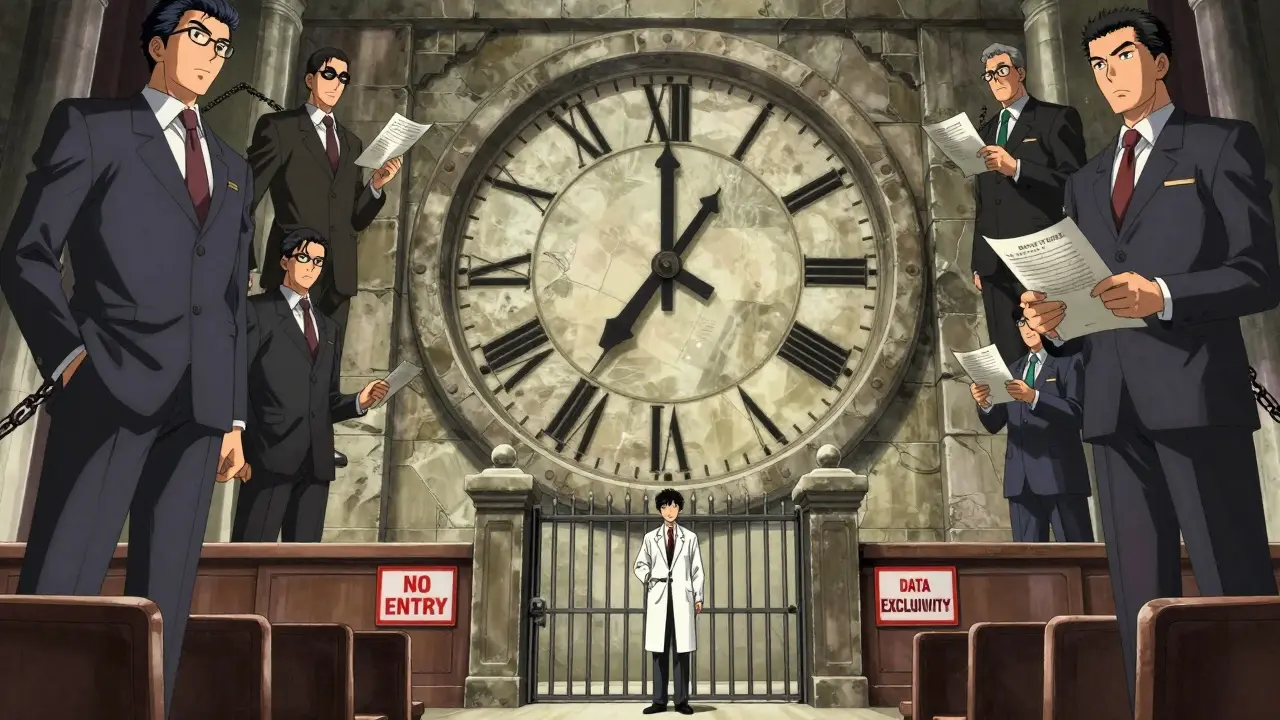
When a biologic drug hits the market, it doesn’t just come with a price tag-it comes with a legal shield. In the U.S., that shield lasts 12 years. For a decade and a half, no biosimilar can even be submitted for approval, and for the first four of those years, no one can file paperwork at all. This isn’t just a technicality-it’s a massive barrier that keeps drug prices high and patients paying more than they should.
How the 12-Year Clock Works
The rules are set by the Biologics Price Competition and Innovation Act (BPCIA) of 2009. It’s not a simple patent expiration. It’s a two-part lock. First, there’s a 4-year data exclusivity period. During this time, no biosimilar company can even submit an application to the FDA. They can’t start the process. They can’t test, they can’t file, they can’t plan. They have to wait. Then comes the 8-year marketing exclusivity period. Now, biosimilar makers can file their applications-but the FDA still can’t approve them. Not until the full 12 years have passed since the original drug got its first license.That 12-year clock starts ticking on the day the original biologic-say, Humira or Enbrel-is approved by the FDA. It doesn’t matter if the company files dozens of other patents after that. The clock doesn’t reset. It doesn’t pause. It runs straight through.
There’s one exception: if the drug maker runs pediatric studies and gets approval for use in children, they can get a 6-month extension. That’s it. No other loopholes. No automatic extensions for minor tweaks. Just the 12 years, plus half a year if they test on kids.
The Patent Dance: A Legal Maze That Delays Entry
Even after the 12-year mark, biosimilars don’t just roll in. There’s another hurdle: the patent dance. It sounds polite, but it’s anything but. It’s a complex, multi-step legal back-and-forth between the original drug maker and the biosimilar applicant.Here’s how it works: within 20 days of the FDA accepting a biosimilar application, the applicant must send the original drug company a full copy of their application and manufacturing details. The original company then has 60 days to list every patent they think might be infringed. The biosimilar maker responds with a legal argument for why each patent doesn’t apply-invalid, unenforceable, or not infringed. Then, both sides get 15 days to negotiate which patents to fight in court right away.
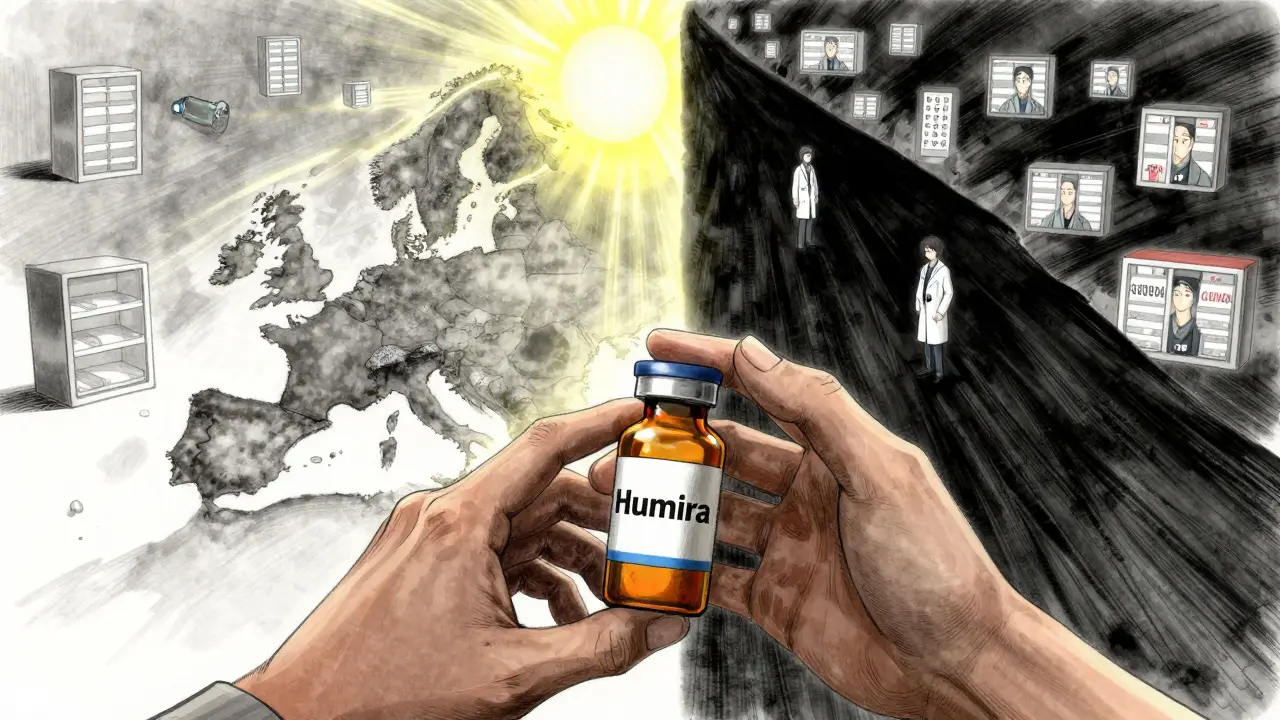
Most of the time, they don’t agree. That’s when the lawsuits begin. And they can drag on for years. In the case of Humira, AbbVie filed over 160 patents-many of them on minor formulation changes or delivery methods-long after the core patent expired. These weren’t breakthroughs. They were legal fences. And they worked. Humira didn’t face a single biosimilar in the U.S. until 2023, even though biosimilars were available in Europe since 2018.
Why the U.S. Is So Much Slower Than Europe
Europe gives biologics only 10 years of data exclusivity, plus one year of market exclusivity-11 total. And biosimilars took off there fast. Today, in countries like Germany and the UK, biosimilars make up 72% of the market for drugs that have them. Prices dropped by 50% to 80% within two years.In the U.S.? Not even close. As of late 2023, only 38 biosimilars have been approved since 2015. In Europe, it’s 88. And the cost difference is staggering. Humira’s price in the U.S. jumped 470% between 2012 and 2022. In Europe, it stayed flat after biosimilars arrived. Patients in the U.S. pay three times more for the same treatment.
Why? It’s not just the law. It’s the culture. U.S. insurers and pharmacies often don’t push biosimilars. Doctors aren’t always trained on them. Patients don’t know they’re safe. And the original drug companies spend millions on marketing to keep their brand dominant-even after the exclusivity period ends.
The Biosimilar Void: 118 Drugs, Fewer Than 12 in Development
Here’s the scary part: 118 biologic drugs are set to lose patent protection between 2025 and 2034. That’s a $234 billion market. But only 12 of those drugs currently have biosimilars in development. That’s a 90% gap.Why? Three big reasons:
- Complexity: Antibody-drug conjugates, bispecific antibodies, and gene therapies cost over $250 million and take 7-10 years to develop. Most companies can’t afford it.
- Orphan drugs: 64% of the expiring biologics are for rare diseases. Small markets mean low returns. Only one orphan biologic, eculizumab, has a biosimilar in the pipeline.
- Patient fear: Many doctors and patients still think biosimilars are like generics-cheaper, but less effective. They’re not. The FDA requires proof of no clinically meaningful differences in safety, purity, or potency.
And here’s the kicker: 88% of expiring biologics with orphan indications have zero biosimilars being developed. That means patients with rare diseases may pay sky-high prices for another decade-or longer.
Who’s Winning? Who’s Losing?
The winners? Big pharma. Companies like AbbVie, Amgen, and Johnson & Johnson have made billions by stretching patents, filing lawsuits, and delaying competition. Their profits are protected by a system designed to encourage innovation-but now it’s being used to block it.The losers? Patients. Pharmacists. Insurance companies. Taxpayers. A 2022 survey by the National Community Pharmacists Association found that 63% of pharmacists have patients who stopped taking their biologic because they couldn’t afford it. The Arthritis Foundation documented cases where patients skipped doses or switched to less effective treatments just to save money.
Health economists estimate that if the U.S. closed the biosimilar gap, we could save $158 billion over the next 10 years. Right now, we’re on track for only $71 billion-because so few biosimilars are being developed.
What’s Being Done? Not Enough
The FDA has tried. Their 2022 Biosimilars Action Plan promised better communication, faster reviews, and more support for developers. But progress is slow. Only 38 biosimilars approved in 8 years? That’s less than five per year. In Europe, it’s over eight per year.Legislation like the Biosimilars User Fee Act of 2022 tried to speed things up by reducing regulatory fees and improving FDA efficiency. But it stalled in Congress. No action. No funding. No change.
Meanwhile, companies like Pfizer and Amgen are investing in biosimilar development-but only for the easiest targets. Complex drugs? Too risky. Orphan drugs? Too small. So they wait. And patients wait with them.
What Needs to Change
We need three things to fix this:- Shorter exclusivity: 12 years is too long. Other countries manage with 10 or 11. The U.S. should follow.
- Limit patent thickets: Congress should ban companies from filing hundreds of weak patents just to delay competition. Only core patents should count.
- Incentivize complex biosimilars: The government should offer grants, tax credits, or guaranteed purchase agreements for biosimilars targeting rare diseases or hard-to-make drugs.
Without these changes, the biosimilar void will keep growing. And patients will keep paying more-just so a few companies can keep their profits.
Can a biosimilar be approved before the 12-year exclusivity period ends?
No. Under the BPCIA, the FDA cannot approve any biosimilar until 12 years after the reference biologic’s first approval date. Even if the original patent expires earlier, the 12-year exclusivity period is a separate legal barrier. There are no exceptions unless the drug receives a pediatric exclusivity extension, which adds six months.
Why are biosimilars more expensive to develop than generic drugs?
Biologics are made from living cells, not chemicals. Their structure is complex, and even tiny changes in manufacturing can affect safety and effectiveness. Developing a biosimilar requires years of testing, analytical comparisons, and often clinical trials to prove it’s "highly similar" with no clinically meaningful differences. This costs $100 million to $250 million. Generic small-molecule drugs, which are chemically identical copies, cost only $1-2 million and take about two years to develop.
Do biosimilars work as well as the original biologic?
Yes. The FDA requires biosimilars to show no clinically meaningful differences in safety, purity, and potency compared to the original. They undergo rigorous testing-including analytical studies, pharmacokinetic studies, and sometimes clinical trials. Thousands of patients have used biosimilars in the U.S. and Europe with the same outcomes as the reference product. They are not "generic versions"-they’re scientifically validated alternatives.
Why haven’t more biosimilars been approved in the U.S.?
Several factors: the 12-year exclusivity period delays entry, patent thickets create legal delays, development costs are high, and many complex biologics (like cell therapies) are too risky for companies to pursue. Also, insurers and prescribers often don’t promote biosimilars, so there’s little market pressure to develop them. Only 12 of the 118 expiring biologics between 2025-2034 currently have biosimilars in development.
What happens after a biosimilar is approved?
Once approved, the biosimilar can be prescribed and dispensed. But it doesn’t automatically replace the original drug. Pharmacies and insurers must include it in their formularies. Doctors need to be educated. Patients need to trust it. In Europe, biosimilars gained rapid adoption because of strong policy support and price competition. In the U.S., adoption has been slow-partly due to marketing by originator companies and lack of provider confidence.
josue robert figueroa salazar
December 27, 2025 AT 03:48This system is rigged.
Matthew Ingersoll
December 28, 2025 AT 06:3812 years is absurd. In Europe, biosimilars cut prices in half within two years. Here? Patients are still getting gouged. We're not protecting innovation-we're protecting profits.
carissa projo
December 30, 2025 AT 03:31I keep thinking about the people who skip doses because they can’t afford Humira. It’s not just a policy failure-it’s a moral one. We call this healthcare, but it feels more like a high-stakes poker game where the house always wins.
And yet, the same people who scream about free markets are silent when it comes to drug pricing. Why? Because the lobbyists write the rules, and the rest of us just pay the bill.
david jackson
December 31, 2025 AT 02:59Let me tell you something that keeps me up at night-there are 118 biologics set to expire between 2025 and 2034, and only 12 have biosimilars in development. That’s not a market gap. That’s a time bomb. And the patients with rare diseases? They’re not just waiting-they’re being forgotten. We’re talking about people who need these drugs to breathe, to walk, to live-and the system is letting them fall through the cracks because the ROI isn’t sexy enough for Big Pharma. It’s not capitalism. It’s cruelty dressed up in lab coats.
Jody Kennedy
December 31, 2025 AT 06:17Yes yes YES. This is the exact conversation we need more of. I work in a clinic and I see patients cry because they can’t afford their meds. Biosimilars aren’t ‘second-rate’-they’re science. And we’re letting corporate greed dictate who gets to live.
Let’s get real: if this were insulin, we’d have riots. Why is it different because it’s an antibody?
christian ebongue
December 31, 2025 AT 11:37patent dance? more like patent tango with a guy who won’t let go of the lead
jesse chen
December 31, 2025 AT 13:47It’s heartbreaking, really. The science is there. The data proves biosimilars are safe. But the fear? It’s not about science-it’s about branding. Patients think ‘biosimilar’ means ‘cheap knockoff.’ They don’t realize it’s the same molecule, just made by a different company after years of testing. And the FDA? They’ve done their job. It’s the rest of us who haven’t.
Doctors need training. Pharmacies need to prioritize. Insurers need to stop rewarding brand loyalty over cost savings. We’re not just losing money-we’re losing trust.
Joanne Smith
December 31, 2025 AT 22:06Let’s be real-AbbVie didn’t invent 160 patents on Humira. They invented a legal strategy. And it worked. Every single one of those patents was a fence post in a field that didn’t need fencing. The FDA approved the biosimilar in 2023? That’s not progress. That’s a delay that cost patients billions.
And now they’re doing it again with other drugs. It’s not innovation. It’s obstruction. And we’re the ones paying for it-with our health, our wallets, our dignity.
Prasanthi Kontemukkala
January 1, 2026 AT 05:31As someone from India, I’ve seen how biosimilars changed access here. We don’t have 12-year locks-we have 10-year windows, and we use them. Millions of patients get life-saving drugs because we didn’t let patents become prisons. The U.S. could do this. It just needs the will.
Alex Ragen
January 2, 2026 AT 12:18Ah, yes-the noble pursuit of profit, sanctified by legislative decree and wrapped in the velvet glove of ‘innovation.’ How quaint. The 12-year exclusivity period is less a reward for R&D and more a tax on human suffering, levied by those who mistake corporate fiduciary duty for moral authority. One wonders whether the Founders envisioned this: a republic where the right to life is contingent upon the solvency of a pharmaceutical balance sheet.
Lori Anne Franklin
January 2, 2026 AT 22:58soo many ppl cant afford meds and we’re still arguing over patents?? like… can we just fix this? i had a friend who took half her dose so it’d last longer… it’s not right.
Sarah Holmes
January 3, 2026 AT 15:57While I appreciate the sentiment expressed herein, I must respectfully contend that the conflation of corporate profitability with ethical malfeasance constitutes a fallacious appeal to emotion. The Biologics Price Competition and Innovation Act was enacted with deliberate intention-to incentivize innovation by ensuring a sufficient return on capital investment. To diminish exclusivity periods without a corresponding increase in public funding for R&D would be to undermine the very engine of medical advancement.
Furthermore, the assertion that ‘patients are dying because of patents’ is both hyperbolic and statistically unsubstantiated. The FDA’s rigorous approval protocols for biosimilars ensure safety. The real issue lies in reimbursement structures, not intellectual property law.
Perhaps, instead of vilifying pharmaceutical entities, we ought to advocate for universal healthcare coverage, which would mitigate cost barriers irrespective of patent status.
Jay Ara
January 4, 2026 AT 04:27in india we make biosimilars for cheap and send them to africa. why cant us do the same? its not about science its about who owns the name
Michael Bond
January 5, 2026 AT 17:3012 years is too long. Change it.