
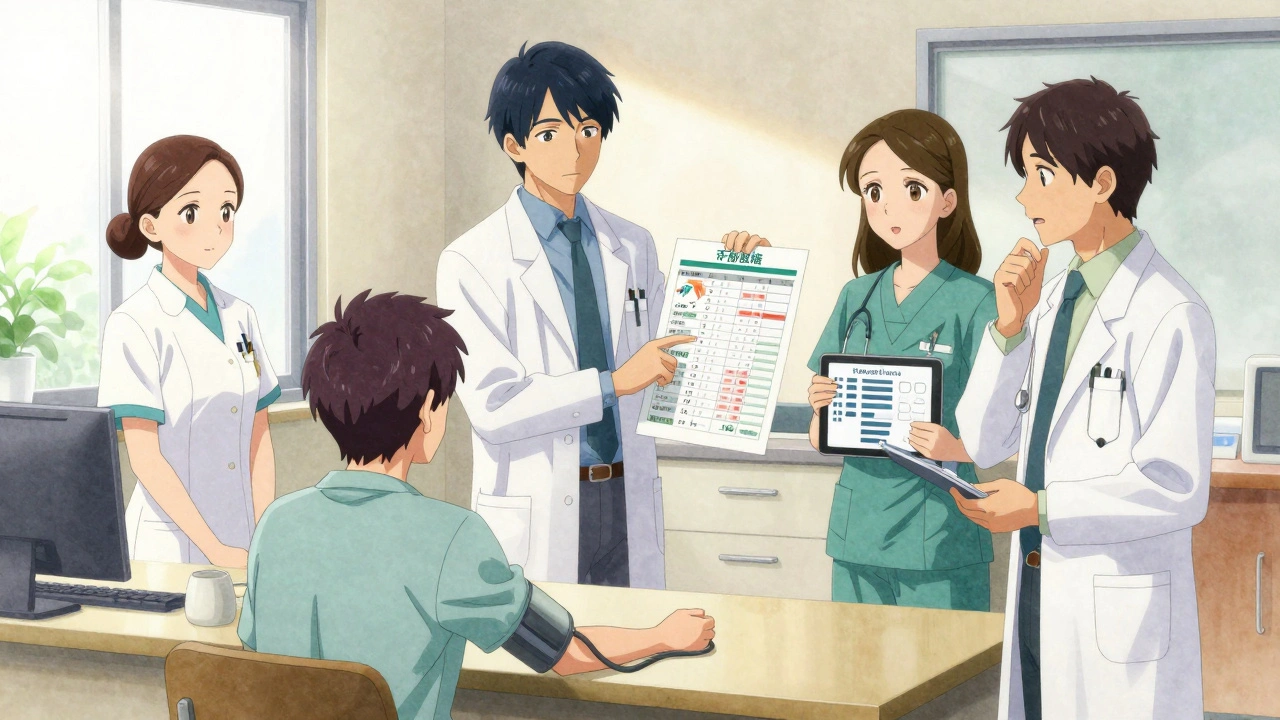
When it comes to prescribing medications, especially generics, the old model-where a doctor makes the call alone-isn’t cutting it anymore. Too many patients are getting the wrong dose, missing refills, or paying too much because no one was looking at the full picture. Team-based care changes that. It’s not a buzzword. It’s a working system where pharmacists, nurses, care coordinators, and doctors all share responsibility for medication decisions. And when it comes to generic drugs, this approach saves money, reduces errors, and actually improves how well patients stick to their treatment.
Why Generic Prescribing Needs a Team
Generic drugs aren’t just cheaper versions of brand-name meds-they’re bioequivalent, FDA-approved, and often just as effective. But many patients don’t know that. Some are afraid they won’t work. Others get confused when their pill changes color or shape. And doctors? They’re overwhelmed. A primary care physician might see 30 patients a day, each on five or more medications. There’s no time to check for interactions, affordability, or adherence. That’s where the team steps in. Pharmacists, trained in drug therapy, take the lead on reviewing all medications. They spot duplicates, flag high-cost options, and recommend generics that match the patient’s clinical needs. Nurses help by checking if the patient is actually taking the meds. Care coordinators make sure everyone’s on the same page-especially when patients switch between specialists and primary care. In one study, when pharmacists were embedded in primary care teams, generic substitution rates jumped by 42%. Not because they pushed cheaper drugs, but because they explained why generics were safe and effective. Patients trusted the advice when it came from a pharmacist who had reviewed their entire regimen.How the Team Works: Roles That Actually Matter
This isn’t just adding more people to the room. It’s about clear roles. Here’s how it breaks down:- Physicians handle complex diagnoses and make final decisions on high-risk medications. They don’t do all the paperwork-they focus on what only they can do.
- Pharmacists conduct comprehensive medication reviews. They check for interactions, assess affordability, and suggest alternatives. In Medicare Part D programs, they’re legally allowed to adjust prescriptions under collaborative practice agreements (CPAs).
- Nurses and Medical Assistants monitor chronic conditions like hypertension or diabetes. They track blood pressure, glucose levels, and side effects. If a patient’s A1C keeps rising, they flag it before the doctor even sees the chart.
- Care Coordinators manage communication. They schedule follow-ups, send refill reminders, and make sure specialist notes reach the primary team. No more lost prescriptions or conflicting advice.
The Real Impact: Numbers That Speak Louder Than Opinions
It’s easy to say “team-based care works.” But here’s what it actually does:- Reduces hospital readmissions by 17.3% by preventing drug-related problems.
- Saves $1,200-$1,800 per patient per year through smarter generic use and fewer ER visits.
- Improves medication adherence by 28% when pharmacists personally counsel patients.
- Cuts medication errors by 67% when pharmacists are part of the prescribing team.
Where It Fails: The Hidden Pitfalls
It’s not perfect. Some teams struggle because roles aren’t clear. A pharmacist might recommend a generic, but if the doctor doesn’t approve it in the system, the patient gets nothing. Or worse-the patient gets confused when two providers give different advice. Communication breakdowns happen. In 12% of cases reviewed by the Commonwealth Fund, patients reported getting conflicting refill instructions from their doctor’s office and pharmacy. That’s not the team’s fault-it’s a system flaw. Another issue? Technology. If the electronic health record (EHR) doesn’t let pharmacists document their recommendations in real time, the team works in silos. One clinic in Texas spent six months just fixing their EHR to show pharmacist notes alongside the doctor’s orders. Before that, the pharmacist’s input was invisible. And then there’s resistance. Some doctors still believe prescribing is their sole domain. One physician on Doximity admitted it took him six months to trust his pharmacist’s suggestions. “I thought they were just trying to cut costs,” he said. “Then I saw the data on adherence. I changed my mind.”How to Build a Team That Actually Works
You can’t just hire a pharmacist and call it a day. Here’s what real implementation looks like:- Month 1-2: Define roles and rules. Who does what? What can a pharmacist change without a doctor’s signature? Use a Collaborative Practice Agreement (CPA)-it’s legally binding and required in most states.
- Month 3-4: Fix your tech. Your EHR must allow pharmacists to document, flag issues, and send alerts to the provider. If it doesn’t, you’re fighting your own system.
- Month 5: Train everyone. Nurses need to know how to flag medication issues. Doctors need to understand what pharmacists can do. Pharmacists need to know how to communicate clearly with non-pharmacists.
- Month 6: Start small. Pilot with 10-20 high-risk patients: those on five or more meds, with diabetes, heart failure, or kidney disease. Track outcomes. Adjust. Then scale.
What’s Next? AI, Telehealth, and Bigger Access
The field is moving fast. In 2023, Medicare lowered the eligibility for Medication Therapy Management from five to four chronic medications. That means millions more patients will qualify for team-based care. Telepharmacy is exploding. Rural clinics that used to have no pharmacist on-site now connect via video to a central team. A patient in West Texas can get a full med review from a pharmacist in Houston-all in 20 minutes. And now, AI is stepping in. At Mayo Clinic, pilot programs use algorithms to suggest generic alternatives based on patient history, cost, and drug interactions. These tools don’t replace pharmacists-they help them work faster. One study showed AI-assisted teams increased appropriate generic use by 22%. Health systems are investing. 92% of healthcare executives plan to expand team-based medication programs by 2026. The only question is whether reimbursement will catch up. Right now, only 41% of these services are paid at full cost. But with CMS pushing for better outcomes and lower costs, that’s changing.
What Patients Are Saying
On Healthgrades, practices using team-based care average 4.7 out of 5 stars. One patient wrote: “The pharmacist caught three interactions my doctor missed. Switched me to generics that saved me $200 a month. I finally feel like someone’s looking out for me.” Another said: “I used to skip my pills because they were too expensive. My pharmacist sat down with me, showed me cheaper options, and even helped me apply for assistance. I haven’t been to the ER in a year.” That’s the power of a team that listens.Frequently Asked Questions
Can pharmacists really prescribe generics without a doctor’s approval?
Yes, in many states, pharmacists can adjust prescriptions under a Collaborative Practice Agreement (CPA) with a physician. These agreements legally allow pharmacists to initiate, modify, or discontinue medications-including switching to generics-for specific conditions like hypertension, diabetes, or high cholesterol. The physician retains oversight, but day-to-day medication adjustments are delegated to the pharmacist, who has specialized training in drug therapy.
Are generic drugs really as good as brand-name ones?
Absolutely. The FDA requires generics to have the same active ingredient, strength, dosage form, and route of administration as the brand-name drug. They must also meet the same strict standards for purity, stability, and bioequivalence. The only differences are in inactive ingredients (like fillers or dyes) and cost. In most cases, generics work identically. Team-based care helps patients understand this, reducing unnecessary fear and resistance.
Why don’t all clinics use team-based care?
The biggest barriers are cost and culture. Setting up a team requires an initial investment of $85,000-$120,000 per practice for staffing, training, and EHR upgrades. Many small clinics can’t afford that upfront. There’s also resistance from providers used to working alone. But the long-term savings-reduced hospitalizations, fewer errors, better adherence-often pay back the investment within 12-18 months.
Who qualifies for team-based medication management?
Under Medicare Part D, patients typically qualify if they have three or more chronic conditions, take five or more medications, and spend more than $4,000 a year on prescriptions. Starting in 2023, the threshold dropped to four medications, adding millions more patients. Private insurers and Medicaid programs have similar criteria, often targeting those with high-risk conditions like heart failure, COPD, or diabetes.
Does team-based care work for acute illnesses?
It’s less effective for sudden, short-term issues like a bad infection or injury. These cases require quick, individualized decisions that don’t allow time for team consultation. But even here, team-based care helps: if a patient comes in with pneumonia and also takes five chronic meds, the team can review those meds to avoid interactions with new antibiotics. The model shines in chronic disease management, where consistency and coordination matter most.
Next Steps for Providers
If you’re a clinician thinking about team-based care, start here:- Identify your highest-risk patients-those on five or more meds, with multiple chronic conditions.
- Partner with a local pharmacy that offers Medication Therapy Management (MTM) services.
- Sign a Collaborative Practice Agreement. Your state’s pharmacy board can help.
- Train your staff. Even a 2-hour workshop on team roles makes a difference.
- Track your results: How many generics did you switch? How many ER visits dropped?



iswarya bala
December 8, 2025 AT 21:55team based care is literally life changing for my grandma she was on 8 meds and now shes on 3 generics and her bp is perfect lol
Noah Raines
December 9, 2025 AT 12:15finally someone gets it. doctors are overloaded and pharmacists are the real MVPs. i wish my old doc had a pharmacist in the room. i’d still be taking that useless $300 brand name pill.
Lola Bchoudi
December 10, 2025 AT 20:58the clinical workflow integration here is textbook multidisciplinary optimization. leveraging CPA frameworks to decentralize therapeutic decision-making while maintaining physician oversight creates a scalable, high-fidelity medication safety net. this isn’t just care coordination-it’s pharmacoeconomic entropy reduction.
Steve Sullivan
December 12, 2025 AT 10:24the system is broken but the solution is beautiful 😊 i mean think about it-what if we stopped treating meds like magic pills and started treating patients like humans? pharmacists talking to people? wild right?
Delaine Kiara
December 12, 2025 AT 22:57oh please. this is just corporate cost-cutting dressed up as healthcare innovation. next they’ll have AI bots prescribing insulin and calling it ‘team-based.’ they don’t care about patients-they care about the bottom line. remember when we used to trust doctors? now we’re trusting a spreadsheet and a pharmacist with a clipboard.
Courtney Black
December 14, 2025 AT 17:47there’s a deeper truth here. we’ve outsourced empathy to algorithms and efficiency to roles. but the real magic isn’t in the CPA or the EHR-it’s in the moment when someone sits down and says ‘let me see your whole list’ and doesn’t rush. that’s not a system. that’s human connection.
and yet we call it ‘protocol.’
we’ve turned care into a checklist and called it progress. the numbers look good. the savings are real. but did anyone ask the patient how it felt to have seven pills reduced to three because someone listened?
the pharmacist didn’t just save money. they saved dignity.
and that’s the metric no spreadsheet can capture.
we don’t need more teams. we need more moments.
and maybe that’s why this works.
George Taylor
December 16, 2025 AT 06:16...and yet, despite the 67% reduction in medication errors... and the 28% increase in adherence... and the $1,800 annual savings per patient... and the 17.3% drop in readmissions... and the fact that patients are actually living longer and falling less... we still have people like Delaine Kiara screaming about ‘corporate cost-cutting’... because, of course, the only possible reason anyone would ever want to improve patient outcomes is to save money... and not because... maybe... just maybe... people care?
It’s exhausting.
ian septian
December 16, 2025 AT 21:11start with 10 high-risk patients. track the numbers. then scale. simple.
Morgan Tait
December 17, 2025 AT 10:20you know who really controls this? Big Pharma. They don’t want you switching to generics-they want you hooked on $500 pills. This ‘team-based care’? It’s a Trojan horse. The pharmacists? They’re plant workers. The EHR updates? Paid for by drug reps. The ‘studies’? Funded by Medicare contracts with CVS. Wake up. This isn’t care-it’s a rebranding of the same old scam.
I’ve seen the invoices. I’ve seen the emails. They’re not saving you money. They’re just moving the profit margin.
Darcie Streeter-Oxland
December 17, 2025 AT 20:16While the conceptual framework presented herein is undeniably compelling, the empirical evidence cited lacks sufficient methodological rigor to warrant systemic adoption. The sample sizes referenced are insufficiently controlled, and the longitudinal outcomes remain unverified by peer-reviewed, multicenter trials. Furthermore, the reliance on self-reported patient satisfaction metrics introduces significant selection bias. Until such time as robust, randomized controlled data is published in the Journal of the American Medical Association, this model remains, at best, anecdotal.
Sarah Gray
December 19, 2025 AT 16:44Of course, the only reason this works is because you're ignoring the fact that pharmacists aren't licensed to diagnose. You're replacing clinical judgment with protocol-driven substitution. This isn't innovation-it's deprofessionalization. And don't get me started on the liability. If a patient has a bad reaction because a pharmacist switched a med without understanding the full neurology? Who's on the hook? The doctor? The pharmacist? The EHR vendor? The system is a lawsuit waiting to happen.
Andrea DeWinter
December 21, 2025 AT 10:42my sister’s a nurse in a rural clinic and they started this last year and now they have a pharmacist on Zoom twice a week and her patients are actually taking their meds for once i swear i cried when she told me one guy stopped going to the ER
you dont need fancy tech just someone who cares enough to check
Raja Herbal
December 22, 2025 AT 13:56so let me get this straight... you’re saying a pharmacist, who spent 6 years learning pharmacology, is better at choosing generics than a doctor who spent 12 years learning medicine? And we’re supposed to believe this isn’t just corporate greed with a nice smile? 😏
Chris Marel
December 24, 2025 AT 13:11i come from a village in nigeria where we dont even have a pharmacy nearby but i read this and i thought-what if we trained community health workers to do med reviews with simple checklists? maybe the solution isnt just tech or teams but just someone who remembers your name
Anna Roh
December 25, 2025 AT 00:04yeah but did they fix the EHR first? because if not, this is just more paperwork.