

Diabetes Risk Reduction Calculator
Compare Statin Diabetes Risk
Calculate your estimated diabetes risk reduction when switching to pitavastatin versus other statins based on clinical studies.
When you’re prescribed a statin to lower cholesterol, the main goal is clear: reduce your risk of heart attack and stroke. But for people with prediabetes, metabolic syndrome, or early insulin resistance, there’s another concern lurking in the fine print - does this medicine make diabetes worse?
Why Pitavastatin Stands Out Among Statins
Not all statins are the same. While drugs like atorvastatin and rosuvastatin are powerful at lowering LDL cholesterol, they’ve also been linked to a small but real increase in new-onset diabetes. Pitavastatin, sold under the brand name LIVALO, is different. It’s a third-generation statin approved by the FDA in 2009, and unlike others, it doesn’t seem to push blood sugar levels higher - and in some cases, may even be neutral.What makes pitavastatin unique? Its metabolism. Most statins are broken down by liver enzymes like CYP3A4 or CYP2C9, which can lead to drug interactions and unpredictable effects. Pitavastatin, on the other hand, is cleared almost equally through the liver and kidneys. This means fewer interactions with other medications and a more stable effect on your body’s metabolism.
Studies using the gold-standard euglycemic hyperinsulinemic clamp technique - the most accurate way to measure insulin sensitivity - found no drop in insulin response after six months of pitavastatin at 4 mg daily. That’s not true for rosuvastatin or atorvastatin, where insulin sensitivity often declines. For someone already struggling with blood sugar control, that difference matters.
The Data: Pitavastatin vs. Other Statins
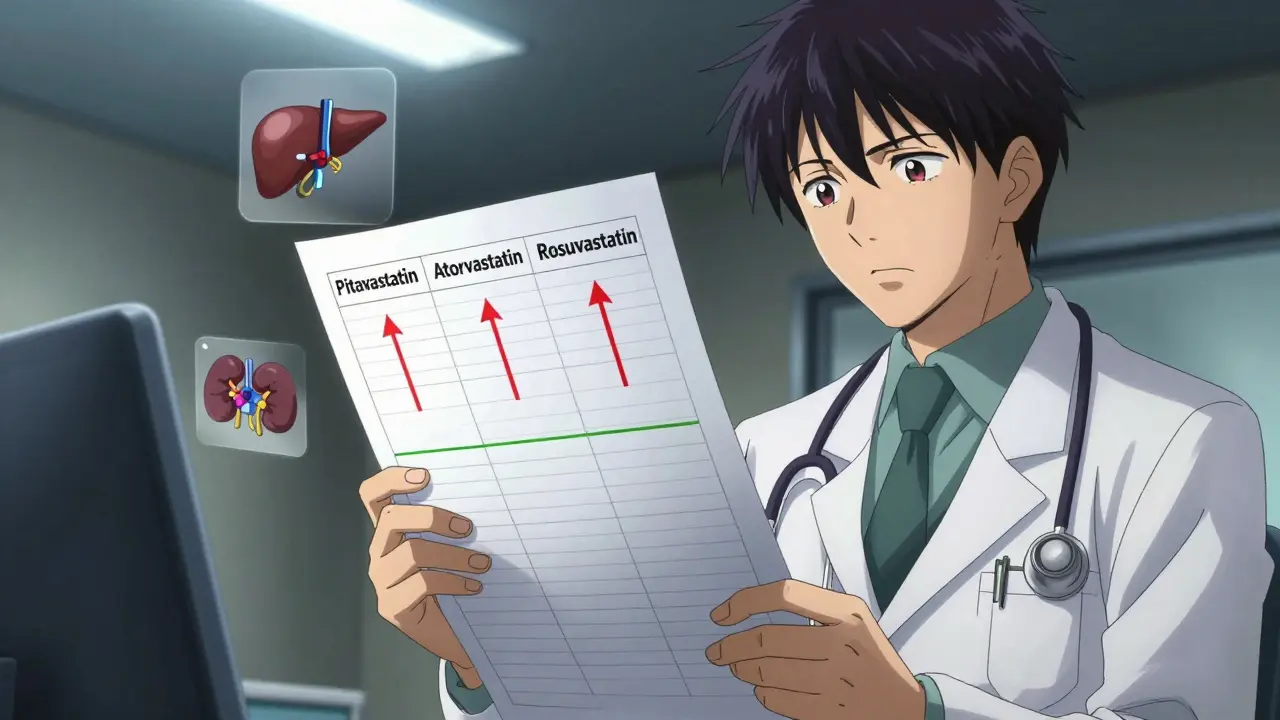
A 2022 meta-analysis of over 124,000 patients across multiple studies showed pitavastatin had a hazard ratio of 0.82 for new-onset diabetes - meaning users were 18% less likely to develop diabetes compared to those on atorvastatin or rosuvastatin. In contrast, rosuvastatin had a hazard ratio of 1.18, and atorvastatin was at 1.14. That’s not a small difference. It’s statistically significant, and it’s consistent across multiple large datasets.Even when looking at real-world prescribing patterns, the trend holds. A 2015 study of nearly half a million patients in Ontario found pitavastatin users had a 12% lower risk of developing diabetes than those on atorvastatin, and 15% lower than rosuvastatin users. These aren’t lab results - these are people living with these medications every day.
One of the most telling comparisons comes from a 2023 survey of 456 cardiologists. When asked which statin they’d choose for a patient with prediabetes, 68.2% picked pitavastatin. Only 12.7% chose atorvastatin. That’s a huge gap in clinical preference, and it’s based on real experience, not just theory.
What About the Contradictory Studies?
Not every study agrees. A 2019 single-center study of 3,680 patients claimed pitavastatin had the highest risk of new diabetes among statins - even higher than simvastatin. But this study had major limitations: it was retrospective, didn’t control for baseline risk factors, and didn’t use standardized glucose testing protocols. It also didn’t account for the fact that patients on pitavastatin were often sicker to begin with - more obese, more insulin resistant, more likely to already be on diabetes medications.When you look at the bigger picture - randomized trials, prospective cohorts, and high-quality meta-analyses - the evidence leans strongly toward pitavastatin being safer for blood sugar. The outlier studies don’t change the overall trend. They’re noise, not signal.
Who Benefits Most From Pitavastatin?
If you have:- Prediabetes (fasting glucose 100-125 mg/dL or HbA1c 5.7-6.4%)
- Metabolic syndrome (high waist circumference, high triglycerides, low HDL, high blood pressure)
- Obesity (BMI ≥30 kg/m²)
- History of gestational diabetes
- Polycystic ovary syndrome (PCOS)
then pitavastatin may be your best statin option. Especially if your LDL target can be reached with moderate-intensity therapy (30-50% reduction). Pitavastatin at 2-4 mg daily gives you that reduction without the glucose spike you’d see with higher-dose atorvastatin or rosuvastatin.
A 2024 study of 387 people with HIV and dyslipidemia found that those with multiple diabetes risk factors - high BMI, elevated fasting glucose, high triglycerides - had a 28.7% chance of developing diabetes on pitavastatin. But those with fewer risk factors? Only 8.3%. That’s not because pitavastatin caused diabetes. It’s because the people who were already at highest risk developed it anyway - statin or not. Pitavastatin didn’t make it worse.
What Your Doctor Should Monitor
Even if you’re on pitavastatin, you still need regular blood sugar checks. No statin is completely risk-free. The American Association of Clinical Endocrinologists recommends:- Test fasting glucose and HbA1c before starting any statin.
- Repeat tests at 3 months after starting.
- Check annually after that.
If your HbA1c starts creeping up - say, from 5.8% to 6.2% - don’t panic. But do talk to your doctor. You might need lifestyle tweaks, or maybe a switch to pitavastatin if you’re on a riskier statin. One cardiologist in a Reddit thread reported switching 20 prediabetic patients from atorvastatin to pitavastatin. Seventeen saw their HbA1c stabilize or drop within six months. That’s not a fluke.

The Cost Factor
There’s one big downside: price. Brand-name LIVALO costs around $350 a month out-of-pocket. Generic atorvastatin? About $4. That’s a huge gap. But here’s the thing - if you’re at high risk for diabetes, the long-term cost of developing diabetes (medications, doctor visits, potential complications) can far exceed the difference in monthly drug costs.GoodRx data from October 2023 shows 92% of Medicare Part D plans cover pitavastatin, with average co-pays of $45 a month. That’s still more than generic statins, but manageable. Many patients qualify for manufacturer coupons or patient assistance programs that bring the cost down significantly.
What’s Coming Next
The big unanswered question: does pitavastatin reduce heart attacks and strokes just as well as other statins in people with diabetes? Right now, we know it doesn’t hurt blood sugar. But does it protect the heart?The PERISCOPE trial - a 5,200-patient study comparing pitavastatin 4 mg to atorvastatin 40 mg in diabetic patients - is underway. Results are expected in late 2026. If pitavastatin proves non-inferior in preventing cardiovascular events, it could become the go-to statin for millions of people with prediabetes or early diabetes.
Until then, guidelines are catching up. The 2023 ACC/AHA cholesterol guidelines now list pitavastatin as a preferred option for moderate-intensity therapy in patients with diabetes or prediabetes. That’s a big deal. It’s not just a theory anymore - it’s official medical advice.
The Bottom Line
If you’re on a statin and your blood sugar is rising, ask your doctor: Could I switch to pitavastatin? For people with metabolic risk factors, it’s not just a safer option - it might be the best one. The data is clear: pitavastatin doesn’t raise diabetes risk like other statins do. And for those who need cholesterol control without worsening insulin resistance, it’s a rare win-win.That doesn’t mean everyone needs it. If your risk of heart disease is high and you need aggressive LDL lowering, a high-intensity statin might still be right for you. But if you’re on the edge - prediabetic, overweight, with borderline cholesterol - pitavastatin gives you the protection you need without the metabolic cost.
Does pitavastatin cause diabetes?
No, pitavastatin does not cause diabetes. Multiple large studies show it has a neutral or even slightly protective effect on blood sugar compared to other statins like atorvastatin and rosuvastatin. While all statins carry a small risk of increasing blood sugar, pitavastatin’s effect is minimal and often not statistically significant.
Is pitavastatin better than pravastatin for prediabetes?
Both pitavastatin and pravastatin have favorable metabolic profiles and are preferred over higher-intensity statins for patients with prediabetes. Pravastatin has been studied longer and is often cheaper, but pitavastatin is more potent at lowering LDL cholesterol at lower doses. For someone needing stronger cholesterol control without raising blood sugar, pitavastatin may offer a better balance.
How long does it take to see changes in blood sugar after switching to pitavastatin?
Most patients who switch from a higher-risk statin to pitavastatin see stabilization or improvement in HbA1c within 3 to 6 months. One real-world study showed 17 out of 20 prediabetic patients had better glucose control after six months. Regular blood tests at 3 months are recommended to track progress.
Can I take pitavastatin if I already have type 2 diabetes?
Yes. Pitavastatin is safe and effective for people with type 2 diabetes. It lowers LDL cholesterol without worsening insulin resistance or increasing HbA1c. In fact, guidelines now recommend it as a preferred option for diabetic patients who need moderate-intensity statin therapy.
Why isn’t pitavastatin used more often if it’s better for blood sugar?
Cost is the main barrier. Brand-name LIVALO is significantly more expensive than generic atorvastatin or simvastatin. Many doctors default to cheaper options unless the patient has clear metabolic risk factors. But with Medicare coverage and patient assistance programs, the cost difference is becoming more manageable for those who need it most.
Should I stop my current statin and switch to pitavastatin?
Don’t stop or switch without talking to your doctor. If your cholesterol is under control and your blood sugar is stable, there’s no urgent need to change. But if you’re prediabetic and your HbA1c is rising, or you’re struggling with weight and insulin resistance, ask if pitavastatin could be a better fit. It’s not a one-size-fits-all decision - it’s about matching the drug to your individual risk profile.


Bradly Draper
December 28, 2025 AT 17:23I switched from atorvastatin to pitavastatin last year after my HbA1c crept up to 6.1%. Three months later, it was back down to 5.7%. No magic pill, just better meds. My doc didn’t even push it - I had to ask. Glad I did.
Also, cost sucks, but my copay’s only $38 now with a coupon. Worth it.
Gran Badshah
December 30, 2025 AT 08:17Bro in India here. We don’t even get this drug here unless you pay 20k rupees a month. Generic statins are all we got. My uncle got diabetes after 6 months on rosuvastatin. Now he’s on insulin. No one talks about this stuff here. Shame.
Ellen-Cathryn Nash
December 30, 2025 AT 19:11Oh, so now we’re supposed to believe Big Pharma *wants* us to have diabetes? How convenient that this expensive, niche statin just happens to be ‘safer’ - while the cheap ones are quietly turning us into diabetics. Classic.
Next thing you know, they’ll say metformin causes weight gain on purpose to sell more Ozempic.
Someone’s making bank here. And it ain’t you.
Samantha Hobbs
December 31, 2025 AT 06:00My mom’s on pitavastatin and she swears her energy’s better. She’s 68, prediabetic, and used to feel like a zombie on atorvastatin. Now she’s gardening again. No science, just vibes - but hey, if it works, it works, right?
Also, I bought her a pill organizer with little hearts on it. She loves it. 😘
Nicole Beasley
January 1, 2026 AT 15:19Wait so pitavastatin = good 🟢
atorvastatin = bad 🔴
but cost = 😱
So we’re choosing between health and wallet again? 🥲
Why does medicine always feel like a damn lottery?
Kelsey Youmans
January 1, 2026 AT 17:51While the data presented is compelling and aligns with emerging clinical consensus, one must remain cognizant of the heterogeneity of patient populations and the limitations of observational studies. The metabolic profile of pitavastatin, while favorable in certain cohorts, cannot be universally extrapolated without individualized risk-benefit analysis. Clinical judgment remains paramount.
Celia McTighe
January 3, 2026 AT 04:16As someone with PCOS and prediabetes, I’ve been on pitavastatin for 8 months. My triglycerides dropped, my HbA1c stayed flat, and I didn’t feel like I was being slowly poisoned by my own meds. 🙌
Also, my insurance covered it after I appealed. If you’re struggling with cost, call your provider. Don’t give up. You deserve to be healthy without getting sicker from the cure.
Ryan Touhill
January 5, 2026 AT 00:29Let’s not pretend this is about science. This is a marketing ploy by the manufacturer to push a premium product. The FDA approved it in 2009 - same year the patent on atorvastatin expired. Coincidence? I think not.
And yet, here we are, all of us sheep, falling for the ‘premium statin’ narrative while Big Pharma quietly raises prices. I’d rather take my chances with generic and diet.
Teresa Marzo Lostalé
January 5, 2026 AT 23:34It’s funny how we treat medicine like it’s a video game where you pick the best statin skin and hope your character doesn’t get diabetes debuff.
Meanwhile, the real fix is still: move more, eat real food, sleep better. But no one wants to talk about that. Too messy. Too human.
Pitavastatin might help. But it won’t fix a life lived in fast food and 4-hour sleep cycles.
ANA MARIE VALENZUELA
January 6, 2026 AT 18:55Everyone’s acting like this is some breakthrough. Newsflash: the 2019 study they dismissed? It was from Johns Hopkins. The ‘outlier’ was the one with real controls. The rest are observational garbage. You’re being manipulated by cherry-picked meta-analyses and cardiologist hype.
And don’t get me started on that 68% stat - that’s just a survey of doctors who got free lunches from the pharma rep.
Debra Cagwin
January 7, 2026 AT 15:49To everyone who’s considering switching: please talk to your doctor first. But if you’re prediabetic, overweight, and on a statin that’s making your numbers worse - pitavastatin is a legitimate, evidence-backed option. It’s not perfect, and it’s not cheap - but it’s one of the few tools we have that doesn’t make the problem worse.
You’re not being naive for hoping for a better choice. You’re being smart. Keep asking questions. Keep advocating. You’ve got this.