
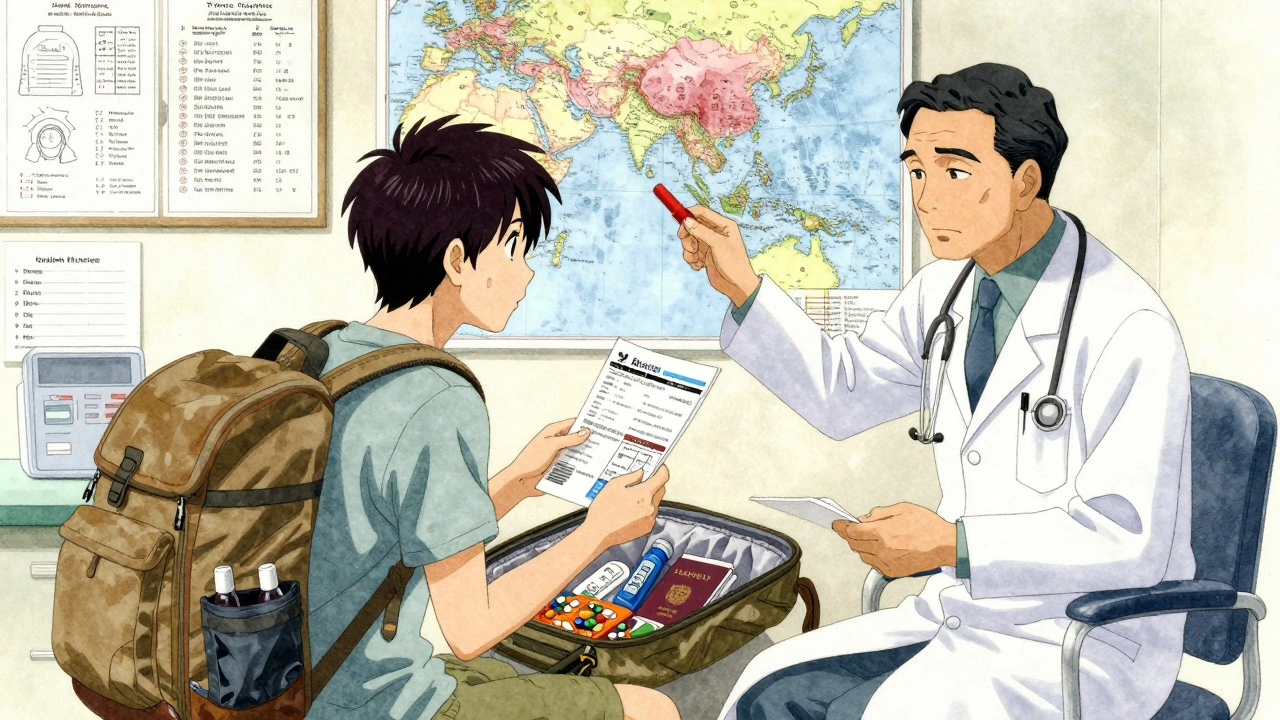
Planning a trip abroad? Skipping a travel health clinic could put you at risk-not just for a bad case of stomach bugs, but for serious illnesses like malaria, yellow fever, or dengue. Most travelers don’t realize that the medications and vaccines they need depend on where they’re going, how long they’ll stay, and even what activities they plan to do. A general doctor might give you a quick checklist, but a travel health clinic gives you a personalized plan built around your exact route, medical history, and risk level. And timing? That’s everything. Waiting until the week before you leave can mean missing critical windows for vaccines or starting anti-malaria drugs on schedule.
Why Travel Health Clinics Are Different
Travel health clinics aren’t just pharmacies with extra shots. They’re specialized centers staffed by providers trained in global health risks. Unlike your primary care doctor, who may only see a few international travelers a year, these clinics handle dozens of destinations weekly. They know which countries require proof of yellow fever vaccination, which regions have drug-resistant malaria, and which areas are seeing new outbreaks of hepatitis A or typhoid.According to the CDC, travelers who visit specialized clinics have 63% fewer health problems abroad compared to those who rely on general advice. Why? Because these clinics don’t just hand out prescriptions-they assess your full situation. Are you hiking in the Andes? You might need acetazolamide for altitude sickness. Going to rural West Africa? You’ll need a specific malaria drug based on local resistance patterns, not just a generic recommendation. Planning to eat street food in Southeast Asia? You’ll get a prescription for azithromycin to treat traveler’s diarrhea on the spot.
They also check for hidden risks. If you’re on immunosuppressants, have diabetes, or are pregnant, your medication plan changes completely. A general practitioner might overlook this. A travel clinic will flag it and adjust your plan accordingly.
What to Bring to Your Appointment
Don’t walk into a travel clinic blind. The more info you bring, the better your plan will be. Here’s what you need:- Exact travel dates and destinations (city names matter-some risks vary by region)
- Itinerary details: Are you staying in hotels or camping? Going on a safari? Taking a river cruise?
- List of all current medications, including supplements
- History of past illnesses, allergies, or surgeries
- Proof of past vaccinations (especially if you’ve had yellow fever or rabies shots before)
- Insurance card and ID
Many clinics ask you to fill out a pre-visit questionnaire online. Do it. It saves time and helps them prepare your personalized recommendations ahead of your appointment.
Key Medications You Might Need
Not everyone needs the same drugs. Your plan is built around your trip. Here are the most common ones:- Malaria prophylaxis: Depending on your destination, you might get atovaquone-proguanil (Malarone), doxycycline, or mefloquine. Malarone is taken daily, starting 1-2 days before travel. Doxycycline starts 1-2 days before, but must be taken daily. Mefloquine starts 2-3 weeks before. Never skip doses-this is how people get sick.
- Yellow fever vaccine: Required for entry into parts of Africa and South America. Must be given at a CDC-registered clinic. You’ll get a small yellow card (International Certificate of Vaccination) that lasts your lifetime. Don’t get it less than 10 days before travel-your body needs time to build immunity.
- Traveler’s diarrhea treatment: Azithromycin (500 mg daily for 3 days) is now preferred over older antibiotics like ciprofloxacin due to rising resistance. The clinic will give you a prescription to carry with you, not to take unless symptoms appear.
- Altitude sickness prevention: If you’re heading above 8,000 feet, acetazolamide (Diamox) at 125 mg twice daily, starting 24-48 hours before ascent, can prevent headaches, nausea, and breathing issues.
- Other vaccines: Hepatitis A and B, typhoid, rabies, Japanese encephalitis-these aren’t one-size-fits-all. Your destination and length of stay determine if you need them.
Some clinics even offer pre-packaged travel kits with meds, hand sanitizer, insect repellent, and first-aid supplies-all labeled with your name and instructions.

Timing Is Everything
This isn’t a last-minute errand. The CDC says you should schedule your appointment 4 to 8 weeks before departure. Why? Because some vaccines need multiple doses spaced weeks apart. The rabies vaccine, for example, requires three shots over 21 days. Mefloquine must be started three weeks ahead. Yellow fever needs 10 days to work. Even if you’re flying out in two weeks, go anyway. You might still get some protection.Waiting until the week before? You might only get a few vaccines, no malaria pills, and no time to adjust if you have side effects. One study found that 28% of preventable malaria cases in U.S. travelers happened because people started their pills too late.
Clinic Options: University, Retail, or Private
Not all clinics are the same. Here’s how they compare:| Type | Cost (Approx.) | Insurance Coverage | Best For | Limitations |
|---|---|---|---|---|
| University-affiliated (e.g., UCLA, UC Davis) | $150-$250 | Usually not covered | Complex itineraries, chronic conditions | Long wait times, no weekend hours |
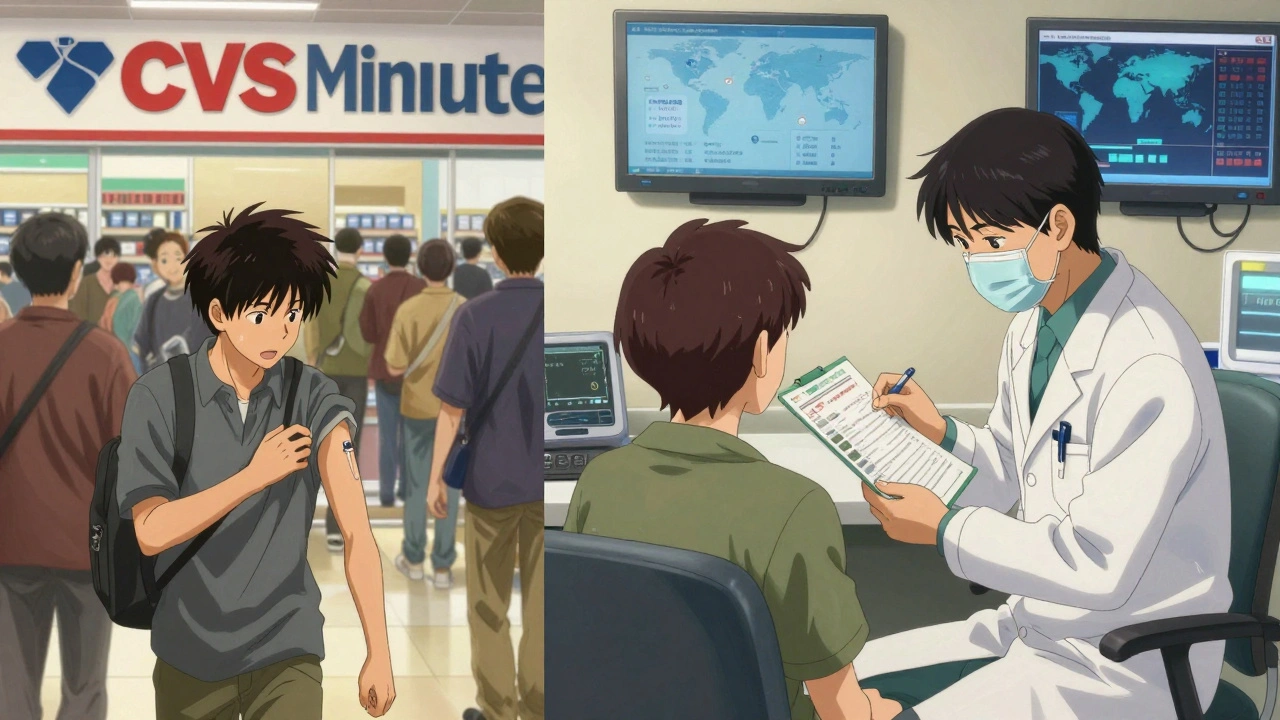
| Retail clinics (CVS MinuteClinic, Walgreens) | $129 | Often covered | Simple trips, routine vaccines | No malaria prescriptions, limited counseling |
| Private travel clinics (e.g., Mayo Clinic, Shoreland) | $200-$350 | Varies | High-risk destinations, chronic illness, complex needs | Higher cost, may require referral |
If you’re going to Southeast Asia with a history of asthma and are staying in remote areas? Go to a private or university clinic. Just heading to Cancun for a week? CVS might be enough. But if you’re unsure, always choose the more thorough option.
What Happens After the Visit
After your appointment, you’ll get:- A printed itinerary with all recommended vaccines and meds
- Prescriptions you can fill at any pharmacy
- Documentation for yellow fever (the official yellow card)
- Written instructions on when and how to take each medication
- Emergency contact info and advice on what to do if you get sick abroad
Many clinics now offer digital access to your records via patient portals. You can download your vaccination history and medication list to your phone. Some even send reminders for when to start your malaria pills.
Don’t forget to refill your prescriptions early. Some meds, like doxycycline, aren’t always in stock at local pharmacies. Order them at least a week before your trip.
Common Mistakes to Avoid
Even smart travelers mess up. Here are the top errors:- Skipping malaria pills because you think you won’t get bitten. Mosquitoes don’t care how careful you are.
- Taking antibiotics at the first sign of stomach upset. Wait until you have three or more loose stools in 24 hours. Overuse leads to resistance.
- Assuming your insurance covers everything. Most travel clinic visits are out-of-pocket. Budget for it.
- Forgetting to pack meds in your carry-on. Checked bags get lost. Keep all meds, prescriptions, and the yellow card with you.
- Not telling the clinic about your supplements. Some herbal products interfere with malaria drugs.
What’s Changing in 2025
Travel medicine is evolving fast. Clinics are now using AI tools that pull real-time outbreak data from the WHO and CDC to update recommendations on the fly. Stanford Health Care is testing genetic tests to see how your body processes drugs-this could soon tell you whether you’re more likely to react badly to mefloquine.Virtual visits are common now. Mayo Clinic has done over 15,000 remote consultations since 2022. You can do your entire appointment from home, get prescriptions sent to your pharmacy, and receive digital instructions.
But the core hasn’t changed: personalized advice, proper timing, and clear instructions still save lives.
Final Checklist Before You Leave
Use this to make sure you’re ready:- ✅ All vaccines completed (including yellow fever if required)
- ✅ Malaria pills started on time and packed in carry-on
- ✅ Traveler’s diarrhea meds on hand with clear instructions
- ✅ Yellow fever certificate in your passport or digital copy
- ✅ List of all meds with generic names (in case you need to refill abroad)
- ✅ Emergency contact numbers saved on your phone
- ✅ Travel insurance that covers medical evacuation
If you’ve checked all these, you’re not just prepared-you’re protected. Travel health clinics exist to turn guesswork into confidence. Don’t skip them. Your trip-and your health-depend on it.
Do I need a travel health clinic if I’m just going to Mexico or the Caribbean?
Even for nearby destinations, yes. Hepatitis A, typhoid, and traveler’s diarrhea are common in Mexico and the Caribbean. Some areas have dengue or Zika outbreaks. A travel clinic can tell you which vaccines or meds are actually needed-most people overestimate the risk and get unnecessary shots, or underestimate and skip critical ones. For simple trips, a retail clinic like CVS might be enough, but don’t assume your regular doctor’s advice is enough.
Can I get malaria pills without seeing a travel clinic?
Technically, yes-if your primary care doctor is willing to prescribe them. But most don’t know the latest CDC guidelines on drug resistance patterns. A 2023 study found that general practitioners prescribed the wrong malaria drug for sub-Saharan Africa 32% of the time. Travel clinics get updated quarterly and know which drugs work where. Plus, they’ll explain how to take them correctly, what side effects to watch for, and what to do if you miss a dose.
How much does a travel health clinic visit cost?
Expect $129-$350 for the consultation, depending on the clinic type. Vaccines and medications are extra and billed separately. Insurance rarely covers the consultation fee, but sometimes covers vaccines if you have a PPO plan. Retail clinics like CVS often accept insurance for vaccines, but not the visit. University clinics rarely take insurance but offer the most comprehensive service. Budget at least $200-$500 total for a typical trip.
What if I only have two weeks before my trip?
Go anyway. While 4-8 weeks is ideal, even last-minute visits can help. You can still get some vaccines (like hepatitis A or typhoid), start malaria pills if there’s time, and get essential meds like azithromycin. You might miss out on full protection for some vaccines (like rabies or Japanese encephalitis), but you’ll still get critical advice on food safety, bug bites, and what to do if you get sick. Better than nothing.
Do I need to bring my passport to the clinic?
Not always, but it’s smart. Some countries require proof of yellow fever vaccination based on your passport’s entry stamps. If you’ve been to a high-risk country before, the clinic needs to know. Also, your passport number may be needed on the yellow fever certificate. Bring it just in case.



Audrey Crothers
December 11, 2025 AT 20:07Just got back from Costa Rica and I can't believe I almost skipped this! I thought 'it's just Central America, I'll be fine'-wrong. Got sick on day 3, and no azithromycin on me. Learned the hard way. Bring the meds. Even if you think you won't need them. Trust me, your future self will cry happy tears.
Also, CVS gave me the yellow fever card and two vaccines in 20 mins. No drama. Do it.
Laura Weemering
December 13, 2025 AT 01:34Ugh. Another 'travel clinic is sacred' sermon. I get it, you're scared of mosquitoes and street food. But let's be real-most people don't need half the crap they're sold. I went to Thailand, skipped the clinic, took a single doxycycline packet I bought online, and had zero issues. Your fear-based marketing is exhausting. Not everyone is a germaphobe with a PhD in travel medicine.
Also, why does every article need 17 subheadings? It's a pill. Not a NASA launch.
sandeep sanigarapu
December 14, 2025 AT 19:40Respectfully, I have traveled to 12 countries in the last 5 years without visiting a travel clinic. I carry basic medications, drink bottled water, and use DEET. My health has been fine. I believe in personal responsibility over institutional advice. Not all risks are equal. Some people overprepare. Others are careless. The truth lies in between.
Ashley Skipp
December 16, 2025 AT 07:58Anyone who pays $300 for a clinic is wasting money. Your doctor can prescribe malaria pills. You don't need a whole seminar on altitude sickness when you're just going to Cancun. Stop being manipulated by fear. I've never been to a travel clinic and I'm still alive. Your insurance won't cover it because it's not medically necessary. Plain and simple.
Robert Webb
December 17, 2025 AT 21:40I really appreciate how detailed this is, especially the breakdown of clinic types. I'm a dad planning a family trip to Kenya next year, and I was overwhelmed until I read this. The part about immunosuppressants and pregnancy adjustments? That's the stuff nobody talks about. My kid has asthma, and I had no idea altitude meds could be relevant even on a safari. I'm booking a private clinic now.
Also, the digital portal thing? Genius. I'm terrible at remembering paper cards. Having it on my phone with reminders for when to start the pills? That’s the kind of thoughtful design that actually saves lives. Thank you for writing this.
One thing I'd add-don't forget to check if your pharmacy can order the meds in advance. Some places take 5-7 days to get doxycycline in stock. I learned that the hard way last year.
nikki yamashita
December 19, 2025 AT 20:43YES. Just did this for Bali and it felt like a superhero prep session. Got my malaria pills, azithromycin, and even a little travel first-aid kit with bandaids and hand sanitizer. Felt so empowered. Don't wait. Even if you're nervous, just go. They're nice. I cried a little from relief. You got this!! 🌏💊
Adam Everitt
December 20, 2025 AT 08:17yeah i went to a clinic last year for japan and they told me i needed japanese encephalitis vaccine… which i later found out is only for rural rice fields in summer. i was staying in tokyo. wasted 120 quid. point is, not all advice is gold. some clinics just wanna sell you stuff. do your own research too. not everything they say is gospel. also, i misspelled ‘encephalitis’ in my notes. oops.
wendy b
December 21, 2025 AT 09:55It is frankly astonishing how many individuals treat preventive medicine as a discretionary luxury rather than a non-negotiable component of responsible global mobility. The notion that a CVS MinuteClinic is sufficient for complex regional pathogen exposure profiles is not merely naïve-it is statistically indefensible. The CDC data cited herein is corroborated by peer-reviewed literature from The Lancet Infectious Diseases, which demonstrates a 68% reduction in preventable morbidity among travelers who undergo comprehensive pre-travel risk stratification. To equate this with a 'vaccine sales pitch' is to fundamentally misunderstand the epistemological framework of tropical medicine. One does not negotiate with Plasmodium falciparum.