

Every year, Americans spend over $400 billion on prescription drugs. About 90% of those prescriptions are for generics-cheaper, just-as-effective copies of brand-name medicines. But here’s the catch: even though generics are cheaper, patients still often get the more expensive brand version. Why? Because the system doesn’t always push them toward the savings.
That’s where states step in. Across the U.S., 46 states have built systems to nudge doctors, pharmacists, and patients toward generics-not by forcing them, but by making it easier and cheaper to choose them. These aren’t just random rules. They’re carefully designed financial and policy incentives, built over decades, to save billions without sacrificing care.
How States Push for Generics: The Tools They Use
States don’t rely on one trick. They layer multiple strategies to make generics the obvious choice.
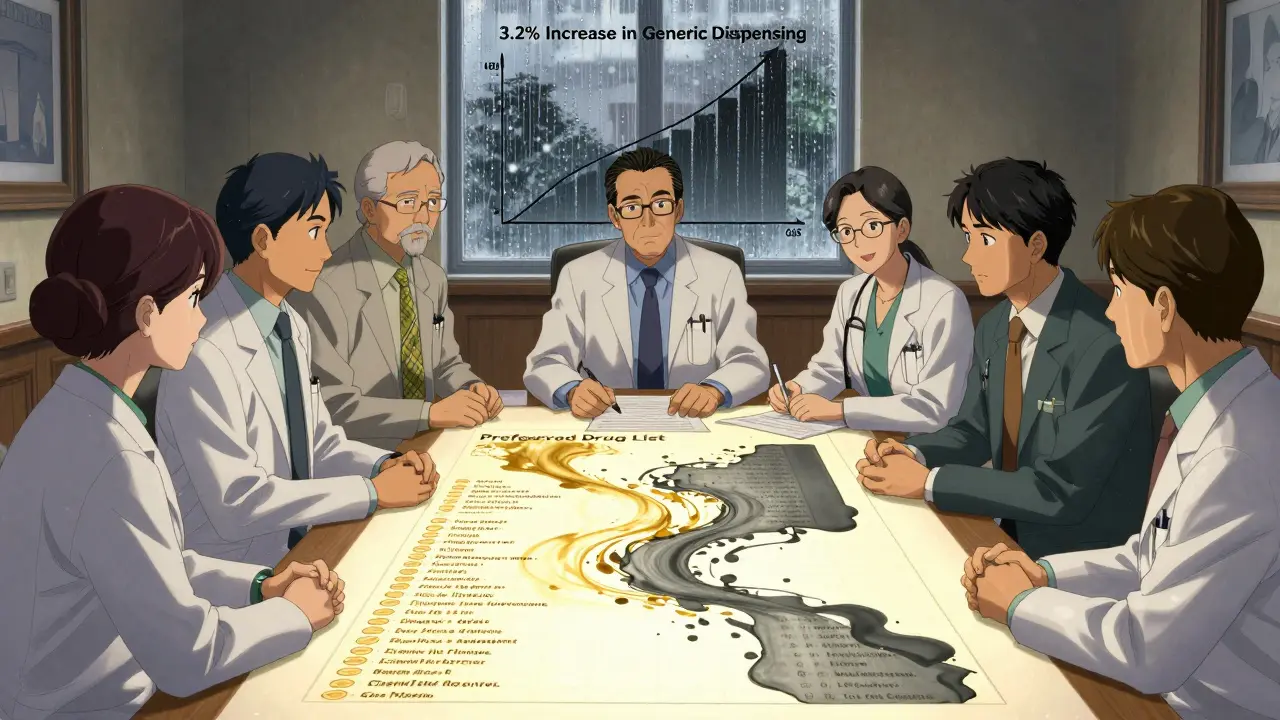
The most common tool is the Preferred Drug List (PDL). Think of it like a grocery store’s weekly sale section. States create a list of generic drugs they prefer-usually because they’re cheaper or come with better rebates. If a doctor prescribes a drug not on the list, the patient pays more. Or the pharmacy has to jump through hoops to get approval. In 2019, 46 states used PDLs for Medicaid prescriptions. That’s nearly every state. And 29 of them let expert pharmacy committees decide which drugs make the list-keeping decisions clinical, not political.
Another big lever is differential copayments. If your copay for a brand-name drug is $40, but the generic is $10, the math is clear. States have been widening this gap for years. In the late 1990s, pharmacies made just 8 cents more dispensing a brand than a generic. But copays? They kept rising. Today, in many states, patients pay three to five times more for the brand. That’s not a mistake-it’s intentional design.
Then there’s pharmacist substitution. When a doctor writes a prescription for, say, Lipitor, can the pharmacist give you atorvastatin-the generic-without asking? In 11 states, yes. That’s called presumed consent. The pharmacist assumes you’re okay with the switch unless you say no. In 39 other states, the pharmacist must ask you first-explicit consent. The difference matters. A 2018 NIH study found that presumed consent laws increased generic dispensing by 3.2 percentage points. That might sound small, but it adds up fast. If all 39 explicit consent states switched to presumed consent, they’d save an estimated $51 billion a year.
Why Some Rules Don’t Work
Not every policy moves the needle. Some states tried mandatory substitution laws-forcing pharmacists to swap brands for generics without any patient input. But studies showed these didn’t do much. Why? Because pharmacists were already swapping generics anyway. They make more profit on them. The real barrier isn’t the pharmacist-it’s the patient’s habit, the doctor’s autopilot prescribing, or the pharmacy’s lack of communication.
States learned that pushing on providers doesn’t work as well as pushing on patients. A 2019 HHS report found that incentives aimed at pharmacists-like higher fees for dispensing generics-had little impact. But when patients felt the cost difference at the register? That changed behavior.
Even Medicaid’s rebate system plays a role. Since 1990, federal law requires drugmakers to give Medicaid a minimum 13% rebate on generics. States then negotiate extra rebates on top. In 2019, 46 states did this. But here’s the twist: sometimes, these rebates backfire. Generic manufacturers can get hit with unexpected inflation rebates-even if they didn’t raise prices. If their costs go up, or if a drug becomes scarce, they might lose money on Medicaid sales. That’s led some companies to pull generics off the market. So while states want more generics, they can’t afford to break the supply chain.
The 340B Program and Hidden Incentives
Beyond Medicaid, there’s another powerful engine: the 340B Drug Pricing Program. Created in 1992, it lets safety-net hospitals and clinics buy drugs at steep discounts-20% to 50% off. Many of these places serve low-income patients. They rely on 340B savings to stay open. And guess what? They overwhelmingly use generics. Why? Because the discounts are biggest on the cheapest drugs.
But here’s the complication: states have to figure out how to reimburse pharmacies that get drugs through 340B. In 2016, CMS told states: don’t pay more than the 340B ceiling price. That meant some pharmacies were getting reimbursed less than what they paid. Some shut down. Others stopped stocking generics. So while 340B encourages generic use, bad reimbursement rules can kill the incentive.
What’s Next? The $2 Drug List
At the federal level, CMS is testing a new idea: the $2 Drug List. It’s simple-any generic drug that costs $2 or less gets a fixed $2 copay for Medicare Part D patients. No confusing tiers. No prior auth. Just $2. It’s a pilot now, but it’s gaining traction. Why? Because it’s easy. Patients understand it. Pharmacists can explain it in five seconds.
States are watching. If it works for Medicare, they’ll likely copy it. Why? Because it cuts through complexity. Instead of managing PDLs, copay tiers, and rebate calculations, you just set a flat price. It’s the opposite of bureaucratic. It’s human.
What Works Best? The Real Winners
Let’s cut through the noise. The most effective state policies aren’t the ones with the most rules. They’re the ones that make the right choice the easiest choice.
Here’s what works:
- Presumed consent substitution-let pharmacists switch unless the patient says no.
- Large copay gaps-make the generic so much cheaper that it’s not even a debate.
- Annual PDL reviews-update lists every year so they reflect real prices and availability.
- Clear patient communication-tell patients why the switch is safe and saves money.
What doesn’t work? Mandatory substitution. Complex prior auth forms. Pharmacist bonuses that nobody understands. The goal isn’t to control behavior-it’s to align incentives.
The Bigger Picture: Savings vs. Sustainability
States aren’t just saving money. They’re trying to keep the generic market alive. But there’s a tension. If rebates are too aggressive, manufacturers leave. If copays are too low, pharmacies lose money. If PDLs are too narrow, patients can’t get the drugs they need.
Avalere Health found five scenarios where generic makers lose money in Medicaid-even if they don’t raise prices. Drug shortages. Rising ingredient costs. Changes in patient volume. Mature markets with too many competitors. These aren’t theoretical. They’re happening right now. And when a generic disappears from the market, it doesn’t come back easily.
That’s why the smartest states don’t just chase the lowest price. They look at reliability. They talk to manufacturers. They track supply chains. They know that a $0.50 generic that’s always in stock is worth more than a $0.30 one that’s out every other week.
And they’re not stopping. With drug costs still rising, and Medicare’s $2 Drug List gaining attention, expect more states to simplify, standardize, and prioritize generics. The goal isn’t just to cut costs today. It’s to build a system where generics stay affordable, available, and trusted-for decades to come.



Arun ana
December 16, 2025 AT 10:50Wow, this is actually one of the most well-explained policy deep dives I’ve read in a while 🙌
Love how it breaks down the real mechanics behind generic adoption-not just the buzzwords.
Presumed consent is genius. Why are we still making patients opt-in to savings? It’s like asking someone if they want free money.
And that $2 drug list? If we can do that for Medicare, why not for everyone? Simple is powerful.
Also, props to states that actually update their PDLs yearly. Too many just set it and forget it until someone gets denied a med.
Also, the 340B reimbursement mess is criminally under-discussed. Pharmacies in rural areas are barely hanging on because of it.
Would love to see a national standard for this. We’re all paying for the chaos one way or another.
Joanna Ebizie
December 18, 2025 AT 05:23So let me get this straight-states are basically bribing people to take cheap meds and calling it ‘policy’?
Next they’ll pay us to eat broccoli and not buy SUVs.
It’s not about savings-it’s about control. They don’t trust us to make our own choices, so they game the system.
And don’t even get me started on ‘expert pharmacy committees’-who the hell are these people?
My doctor didn’t go to med school to be told what to prescribe by some bean counter in a state office.
Generics are fine, but if I want Lipitor, I should be able to get it without jumping through hoops.
This is the slippery slope to government deciding what’s ‘good for you.’
And now they want to make everything $2? What’s next-free insulin but you can’t pick the brand?
Y’all are just enabling the system to keep squeezing pharma while pretending it’s ‘for the people.’
Dylan Smith
December 19, 2025 AT 19:32the $2 list is the only thing that makes sense
why do we need 12 tiers and prior auth for a $0.50 pill
pharmacists should just hand it over and move on
people don’t care about the brand if it works
my grandpa takes generic metformin and he’s still alive at 89
stop overcomplicating healthcare
just make the cheap stuff easy
that’s it
done
Billy Poling
December 21, 2025 AT 00:53While the article presents a compelling narrative regarding state-level interventions aimed at promoting generic drug utilization, it is imperative to recognize that the underlying economic structures governing pharmaceutical pricing are far more complex than the simplified framework implied.
Indeed, the reliance upon differential copayments and presumed consent mechanisms may yield short-term fiscal efficiencies, yet they simultaneously risk undermining patient autonomy and the physician-patient therapeutic alliance, both of which are foundational to ethical medical practice.
Furthermore, the assumption that generic equivalency guarantees identical clinical outcomes is not universally valid, particularly in the context of narrow therapeutic index medications such as warfarin or levothyroxine, where even minor bioavailability variations can precipitate clinically significant adverse events.
Additionally, the article’s omission of the role played by direct-to-consumer advertising in sustaining brand-name drug demand represents a critical lacuna, as marketing expenditures by pharmaceutical companies exceed $6 billion annually in the United States alone, effectively shaping prescriber and patient preferences irrespective of cost-effectiveness data.
Moreover, the economic incentives embedded within the 340B program, while ostensibly designed to benefit safety-net providers, have been exploited by certain hospital systems to generate substantial ancillary revenue streams, thereby distorting the original intent of the legislation.
It is also worth noting that the regulatory environment surrounding generic drug approval by the FDA, while rigorous, does not always account for the variability in excipients or manufacturing processes across different suppliers, which may influence patient adherence and tolerability.
Consequently, while the policy mechanisms described may reduce out-of-pocket expenditures, they do not address the root cause of pharmaceutical inflation, which stems from patent extensions, market exclusivity loopholes, and the consolidation of generic manufacturers into a handful of corporate entities.
Therefore, a more holistic approach-encompassing price transparency mandates, importation reforms, and the establishment of public manufacturing capacity-is required to ensure sustainable, equitable access to essential medications.
Without such structural reforms, the current patchwork of state-level incentives may merely serve as a Band-Aid on a hemorrhaging system.
Ron Williams
December 21, 2025 AT 03:53As someone who grew up in a town where the only pharmacy closed because they couldn’t afford to stock generics due to reimbursement issues, I’ve seen this play out firsthand.
It’s not about politics-it’s about keeping the lights on at the corner drugstore.
When states pay pharmacists less than what they paid for the drug, nobody wins.
And yeah, the $2 list? That’s the kind of thing that actually works because it doesn’t require a degree in pharmacy policy to understand.
People get it. No forms. No calls. Just $2.
And if we can do that for Medicare, why not Medicaid? Why not private insurance?
It’s not radical. It’s common sense.
Also, big props to the states that actually talk to manufacturers instead of just slapping on more rebates.
Supply chain isn’t magic-it’s logistics.
Fix the logistics, and the rest follows.
Kitty Price
December 22, 2025 AT 23:37love the presumed consent thing 😊
why do we have to ask every time? like, if i’m getting a pill for blood pressure and it’s the same chemical, just cheaper… just give it to me 😅
also the $2 list is my new favorite idea
why is everything so complicated??
just make it cheap and easy. that’s it.
thank you for writing this
someone finally said what i’ve been thinking for years
Randolph Rickman
December 24, 2025 AT 04:37This is one of those rare posts that actually gives you hope.
You read about healthcare and it’s all doom and profit and bureaucracy-but here’s proof that smart, simple policy can change lives.
Presumed consent? Genius.
$2 generics? Brilliant.
Updating PDLs yearly? Long overdue.
And you know what? It’s not about forcing people-it’s about removing friction.
People aren’t stupid. If you make the right choice easy, they’ll take it.
And the fact that pharmacists are already swapping generics? That’s the real win.
They’re the frontline heroes here.
Let’s stop overcomplicating this.
Let’s scale what works.
And let’s stop letting big pharma play games with our health.
This is the kind of policy we should be shouting from the rooftops.
Good job, states. Keep going.
Elizabeth Bauman
December 25, 2025 AT 05:29They’re lying to you.
Every single one of these ‘savings’? It’s just a backdoor to rationing.
They don’t care about your health-they care about your taxpayer dollars.
And who gets hurt? The elderly. The disabled. The ones who need brand-name meds because ‘generic’ isn’t always the same.
And now they want to force $2 pills on everyone?
Who’s making these pills? China.
And you think they’re not cutting corners?
You think the FDA is watching every batch?
Wake up.
This isn’t healthcare reform.
This is a socialist takeover disguised as a savings plan.
They’ll take away your choices, then blame you when you get sick.
And when the generics fail? You’ll be stuck with a broken system and no recourse.
They’ve been doing this for decades.
And you’re cheering for it?
Look at the data.
Look at the recalls.
Look at the shortages.
This isn’t progress.
This is surrender.
Colleen Bigelow
December 25, 2025 AT 18:29Oh sweet mother of the Constitution, this is the most dangerous nonsense I’ve read since the last time someone said ‘trust the science’ while pushing a vaccine mandate.
Let me guess-the same people who told us ‘lockdowns saved lives’ are now telling us ‘let pharmacists swap your meds without asking’?
They don’t want you to have a choice.
They want you to be a passive consumer of state-approved pharmaceuticals.
And let’s not pretend the 340B program isn’t a slush fund for hospital CEOs.
And the $2 list? That’s the first step to nationalized drug pricing.
Next thing you know, the government will be printing your prescriptions and mailing them to you.
They’ve been grooming this for years.
Generics are fine-but only if YOU choose them.
Not if some bureaucrat in a state capitol decides you’re ‘better off’ without your brand-name insulin.
They’re not saving money.
They’re taking control.
And you’re clapping like a trained seal.
Mike Smith
December 26, 2025 AT 22:29Thank you for this thoughtful, well-researched breakdown.
It’s rare to see policy analysis that doesn’t devolve into partisan noise.
The emphasis on patient-centered design-making the right choice the easiest choice-is not just smart, it’s humane.
Presumed consent isn’t coercion; it’s efficiency grounded in trust.
And the $2 Drug List? That’s the kind of innovation that deserves to go national.
It’s not about lowering standards-it’s about raising accessibility.
Let’s not forget: for millions of Americans, choosing between food and medication isn’t hypothetical.
These policies don’t just save money-they save lives.
And they do it without sacrificing quality.
Let’s celebrate the states that got this right.
And let’s push the rest to follow.
This is the kind of leadership we need more of.
Aditya Kumar
December 28, 2025 AT 02:23yeah ok cool
so generics are cheaper
got it
whatever
can i go now
Ron Williams
December 29, 2025 AT 11:23Actually, I think the biggest win here is the annual PDL reviews.
Too many states treat their lists like ancient tablets-written once and never touched.
But if you update them every year, you’re not just saving money-you’re keeping up with the market.
And that’s what makes this sustainable.
It’s not a one-time fix.
It’s a living system.
And that’s rare in government.